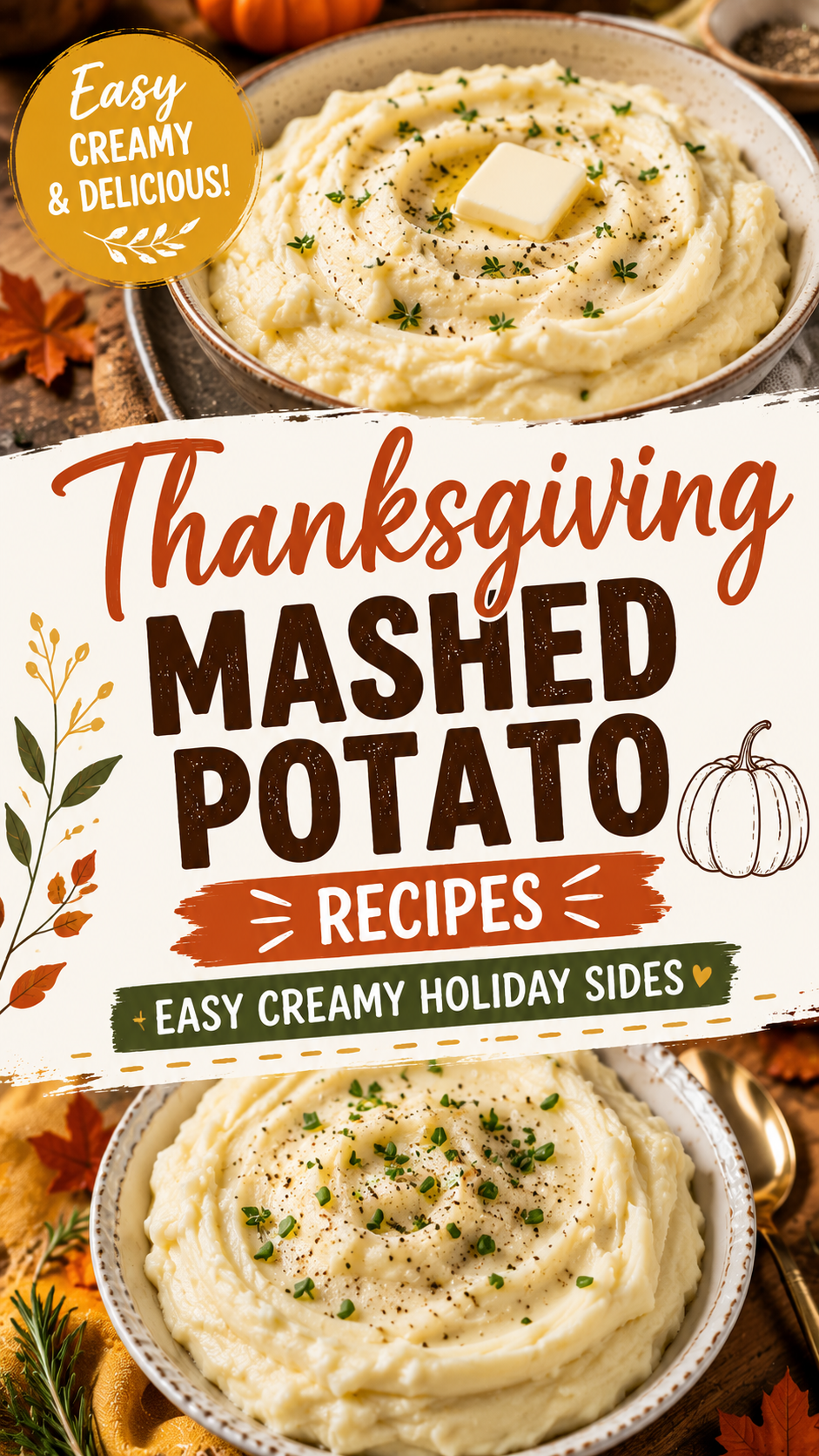
Mashed potatoes have a fairly serious job at Thanksgiving.
They need to be creamy enough for people to take seconds, sturdy enough to hold a generous spoonful of gravy, and easy enough to make while the turkey, stuffing, rolls, and three different casseroles are all demanding attention.
Nobody wants Thanksgiving mashed potatoes that require constant supervision.
These five mashed potato recipes give you a mix of classic and slightly different options: buttery garlic mashed potatoes, roasted garlic Parmesan potatoes, cream cheese mashed potatoes, brown butter herb potatoes, and loaded cheddar mashed potatoes.
Each recipe serves roughly 6 to 8 people as a holiday side, depending on what else is on the table.
1. Classic Buttery Garlic Mashed Potatoes
There is a reason classic mashed potatoes keep returning every Thanksgiving.
They work with everything.
Turkey, ham, stuffing, green beans, cranberry sauce, and especially gravy all get along with a bowl of buttery potatoes.
What You’ll Need
- 3 pounds Yukon Gold potatoes
- 5 garlic cloves, peeled
- 6 tablespoons unsalted butter
- 3/4 cup whole milk
- 1/2 cup heavy cream
- 1 1/2 teaspoons salt, plus more for the cooking water
- 1/2 teaspoon black pepper
- 2 tablespoons chopped chives or parsley
Cook the Potatoes
Peel the potatoes completely or leave a little skin on for texture.
Cut them into roughly 1 1/2-inch pieces.
Try to keep the pieces similar in size so they finish cooking together.
Place the potatoes and garlic in a large pot.
Cover with cold water by about an inch.
Salt the water generously.
Bring to a boil, then reduce to a steady simmer.
Cook for approximately 15 to 20 minutes, until the potatoes are completely tender when pierced with a fork.
Drain well.
Let Them Dry
Return the drained potatoes to the warm pot.
Place over low heat for about 1 minute, gently moving them around.
This helps remove excess moisture.
It is a small step that makes a noticeable difference.
Turn off the heat.
Mash
Warm the butter, milk, and cream in a small saucepan or microwave-safe container.
Do not boil.
Mash the potatoes and garlic.
Gradually add the warm dairy until the potatoes reach your preferred consistency.
Season with salt and pepper.
Finish with chives or parsley.
Serve with another small pat of butter on top.
Because apparently six tablespoons of butter can still benefit from representation at the table.
2. Roasted Garlic Parmesan Mashed Potatoes
Regular garlic gives potatoes plenty of flavor.
Roasted garlic does something different.
It becomes softer, sweeter, and much less sharp, which means you can use an entire head without making the potatoes taste aggressively garlicky.
Parmesan adds a salty, savory finish.
What You’ll Need
- 3 pounds Yukon Gold potatoes
- 1 whole head garlic
- 1 teaspoon olive oil
- 5 tablespoons unsalted butter
- 3/4 cup whole milk
- 1/2 cup heavy cream
- 1 cup finely grated Parmesan
- 1 teaspoon salt, plus cooking water salt
- 1/2 teaspoon black pepper
- 1 tablespoon chopped parsley
- 1 teaspoon chopped fresh thyme
Roast the Garlic
Heat the oven to 400°F.
Slice the top from the garlic head so the tops of the cloves are exposed.
Drizzle with olive oil.
Wrap loosely in foil.
Roast for about 35 to 45 minutes, until the cloves are very soft and lightly golden.
Let the garlic cool enough to handle.
Squeeze the soft cloves from their skins.
Cook the Potatoes
Place peeled and chopped potatoes in cold salted water.
Bring to a boil.
Reduce to a simmer and cook for 15 to 20 minutes.
Drain thoroughly.
Return them to the warm pot for about a minute to remove excess moisture.
Bring Everything Together
Mash the roasted garlic into the potatoes.
Warm the butter, milk, and cream.
Gradually mix them into the potatoes.
Fold in Parmesan.
Add salt, pepper, parsley, and thyme.
Taste before adding extra salt.
Parmesan has already arrived with opinions.
3. Cream Cheese Make-Ahead Mashed Potatoes
Thanksgiving morning becomes easier when at least one important side dish is already handled.
These potatoes are designed with that in mind.
Cream cheese and sour cream give them enough richness to stay creamy after refrigeration and reheating.
What You’ll Need
- 3 pounds russet or Yukon Gold potatoes
- 6 tablespoons unsalted butter, divided
- 8 ounces cream cheese, softened
- 1/2 cup sour cream
- 1/2 to 3/4 cup whole milk
- 1 teaspoon garlic powder
- 1 1/2 teaspoons salt, plus cooking water salt
- 1/2 teaspoon black pepper
- 2 tablespoons chopped chives
Cook and Mash
Peel and cut the potatoes.
Place them in a large pot.
Cover with cold salted water.
Simmer for 15 to 20 minutes, until very tender.
Drain well.
Return the potatoes to the pot briefly to dry.
Mash while hot.
Add 4 tablespoons butter, cream cheese, sour cream, garlic powder, salt, and pepper.
Gradually add warm milk until creamy.
Fold in the chives.
Make Them Ahead
Transfer the potatoes to a lightly buttered baking dish.
Dot the remaining 2 tablespoons butter over the top.
Cover and refrigerate promptly.
For best results, prepare them up to one day ahead.
Reheat for Thanksgiving
Bake covered at 350°F until thoroughly hot, generally around 30 to 40 minutes depending on the depth of the dish and how cold it is when it enters the oven.
Stir once if practical.
If the potatoes seem thick, stir in a splash of warm milk.
Reheated leftovers should reach 165°F.
This is the recipe for anyone who has ever reached Thanksgiving afternoon and discovered the potato peeler still sitting there accusingly.
4. Brown Butter Herb Mashed Potatoes
Brown butter gives mashed potatoes a toasted, nutty flavor without requiring many extra ingredients.
Sage and thyme make them especially good beside turkey and stuffing.
They taste familiar enough for traditional Thanksgiving dinner, but different enough that people notice.
What You’ll Need
- 3 pounds Yukon Gold potatoes
- 8 tablespoons unsalted butter
- 3/4 cup whole milk
- 1/2 cup heavy cream
- 1 tablespoon chopped fresh sage
- 1 teaspoon fresh thyme leaves
- 1 1/4 teaspoons salt, plus cooking water salt
- 1/2 teaspoon black pepper
- 1 tablespoon fresh lemon juice, optional
Cook the Potatoes
Peel and cut the potatoes.
Cook in salted water until completely tender, about 15 to 20 minutes after the water reaches a simmer.
Drain.
Return them to the warm pot for a minute.
Brown the Butter
Place the butter in a light-colored saucepan over medium heat.
Let it melt.
It will foam.
Continue cooking while swirling the pan occasionally.
Watch for small golden-brown flecks at the bottom and a nutty aroma.
Immediately reduce the heat.
Add sage and thyme.
Cook for about 20 to 30 seconds.
Reserve about 2 tablespoons of the browned butter for serving.
Mash
Warm the milk and cream.
Mash the potatoes.
Gradually add the warm dairy.
Stir in the remaining brown butter and herbs.
Season with salt and pepper.
Add lemon juice if you want a subtle bit of brightness.
Spoon the reserved brown butter over the top.
Watch the butter closely while browning.
It spends several minutes doing almost nothing interesting and then suddenly develops a very ambitious schedule.
5. Loaded Cheddar Mashed Potatoes
These are not the quiet mashed potatoes.
Cheddar, bacon, sour cream, and chives turn them into something closer to a loaded baked potato in mashed form.
They’re particularly useful if your Thanksgiving menu is otherwise fairly traditional and you want one richer side.
What You’ll Need
- 3 pounds russet potatoes
- 6 tablespoons unsalted butter
- 3/4 cup warm whole milk
- 1/2 cup sour cream
- 1 1/2 cups shredded sharp cheddar
- 6 slices bacon, cooked until crisp and crumbled
- 1/3 cup chopped chives
- 1 teaspoon salt, plus cooking water salt
- 1/2 teaspoon black pepper
- 1/2 teaspoon garlic powder
Make the Potatoes
Peel and cut the russets.
Place them in cold salted water.
Bring to a boil and simmer until tender, about 15 to 20 minutes.
Drain thoroughly.
Return them to the pot briefly to remove excess moisture.
Mash.
Add butter.
Gradually mix in warm milk.
Stir in sour cream, garlic powder, salt, and pepper.
Fold in about 1 cup cheddar, most of the bacon, and most of the chives.
Transfer to a serving bowl.
Top with the remaining cheese, bacon, and chives.
If you want the cheese completely melted, transfer the potatoes to a baking dish and warm briefly in a 350°F oven.
This is probably not the mashed potato recipe to choose if the table already contains macaroni and cheese, cheesy corn casserole, and potato gratin.
Thanksgiving plates have limits.
In theory.
Which Mashed Potatoes Should You Make?
| Recipe | Texture | Main Flavor | Make Ahead |
|---|---|---|---|
| Buttery Garlic | Smooth and creamy | Classic garlic butter | Yes |
| Roasted Garlic Parmesan | Rich and savory | Roasted garlic | Yes |
| Cream Cheese | Extra creamy | Mild and tangy | Excellent |
| Brown Butter Herb | Creamy | Nutty and herby | Yes |
| Loaded Cheddar | Thick and rich | Cheddar and bacon | Yes |
For the most traditional Thanksgiving dinner, choose buttery garlic.
If you’re preparing potatoes the day before, the cream cheese version is especially forgiving.
For something a little different without becoming strange, make brown butter herb potatoes.
Tools You’ll Need
- Large stockpot
- Colander
- Potato peeler
- Sharp knife
- Cutting board
- Potato masher or potato ricer
- Small saucepan
- Measuring cups and spoons
- Rubber spatula or wooden spoon
- Baking dish for make-ahead potatoes
A potato ricer is useful when you want especially smooth potatoes.
A regular masher works perfectly well.
A blender does not.
More on that particular Thanksgiving hazard shortly.
Pro Tips for Creamier Mashed Potatoes
Start the potatoes in cold water. This helps them cook more evenly.
Cut them into similar pieces. Tiny pieces and giant chunks will not become tender at the same time.
Salt the cooking water. Seasoning only at the end doesn’t produce quite the same result.
Drain thoroughly. Extra water works against creamy potatoes.
Warm the butter and dairy. Cold milk cools the potatoes and can make them less pleasant to mix.
Most importantly:
Stop mixing when the potatoes are creamy.
Mashed potatoes do not reward enthusiasm indefinitely.
Yukon Gold vs. Russet Potatoes
Both are good choices, but they produce slightly different results.
Yukon Gold
Yukon Gold potatoes naturally taste buttery and produce creamy, slightly denser mashed potatoes.
They’re especially good for:
- Garlic mashed potatoes
- Brown butter potatoes
- Parmesan potatoes
Russet
Russets are higher in starch and produce lighter, fluffier potatoes.
They’re excellent for:
- Classic mashed potatoes
- Loaded potatoes
- Baked mashed potato casseroles
You can also use a combination.
Half Yukon Gold and half russet gives you some of the buttery texture of one and fluffiness of the other.
The Secret to Mashed Potatoes That Aren’t Gluey
Potatoes contain starch.
When they’re aggressively processed, more starch gets released.
That is why a food processor or blender can turn fluffy potatoes into something surprisingly close to wallpaper paste.
Use:
- Potato masher
- Potato ricer
- Food mill
Avoid:
- Blender
- Food processor
A stand mixer can work, but use low speed and stop quickly.
There is a point where mashed potatoes are finished.
Continuing to mix them does not unlock a secret second level of creaminess.
Butter First or Milk First?
For especially rich mashed potatoes, add butter before most of the milk or cream.
The fat coats some of the starch and helps create a luxurious texture.
Then add warm dairy gradually.
This also gives you more control.
You can always add another splash of milk.
Removing it from potatoes is a much more advanced procedure.
How Much Milk Should You Add?
Treat the liquid amounts in mashed potato recipes as a useful range rather than an unbreakable law.
Different potato varieties absorb liquid differently.
How thoroughly you drain them matters too.
Start with less.
Mash.
Check the consistency.
Then add more warm milk or cream as needed.
You want potatoes that hold their shape on a spoon while still feeling creamy.
Especially at Thanksgiving.
Gravy needs somewhere to live.
Easy Substitutions and Variations
Whole milk: Use half-and-half for richer potatoes.
Heavy cream: Replace with additional whole milk for a lighter result.
Sour cream: Plain Greek yogurt can work, though the flavor will be tangier.
Parmesan: Try Pecorino Romano, using less salt because it is quite salty.
Cheddar: Gruyère works well.
Chives: Use finely chopped green onions.
Fresh herbs: Dried herbs work, but use less because their flavor is more concentrated.
Bacon: Leave it out for vegetarian loaded potatoes.
For dairy-free mashed potatoes, use a suitable unsweetened plant-based milk and dairy-free butter.
Make sure the milk is unsweetened and unflavored.
Vanilla mashed potatoes would certainly be memorable.
That is not the same as successful.
Thanksgiving Mashed Potato Flavor Ideas
Once you have a reliable basic recipe, mashed potatoes are easy to change.
Try adding:
- Roasted garlic
- Caramelized onions
- Fresh rosemary
- Fresh thyme
- Sage
- Parmesan
- Gruyère
- Cheddar
- Cream cheese
- Sour cream
- Brown butter
- Horseradish
- Chives
Pick one or two main flavors.
You don’t need garlic, cheddar, bacon, Parmesan, sage, rosemary, cream cheese, and caramelized onions in the same bowl.
The potatoes have already agreed to carry the gravy.
Give them a manageable workload.
How Many Mashed Potatoes Per Person?
For Thanksgiving, plan around 1/2 pound of raw potatoes per person when mashed potatoes are an important side.
For 6 people, around 3 pounds works well.
For 8 people, consider 4 pounds.
For 12 people, around 5 to 6 pounds is a reasonable starting point.
You can reduce the amount slightly if you’re serving a very large collection of sides.
You can increase it if your family considers mashed potatoes less of a side dish and more of a Thanksgiving operating system.
Make-Ahead Mashed Potatoes
Mashed potatoes can absolutely be prepared ahead.
The trick is keeping them moist.
Cream cheese, sour cream, butter, and cream all help potatoes survive reheating.
Prepare them one day ahead.
Transfer to a baking dish.
Cover and refrigerate promptly.
On Thanksgiving, reheat them until thoroughly hot.
Add a little warm milk or cream if they have thickened.
Finish with fresh butter and herbs before serving.
This is one of the easiest ways to remove a major last-minute job from Thanksgiving dinner.
Keeping Mashed Potatoes Warm
If dinner is only slightly delayed, keep the potatoes covered in a warm place for a short period.
For longer holding, a slow cooker can be useful.
Transfer fully cooked, hot mashed potatoes into a preheated slow cooker and use the WARM setting according to the manufacturer’s instructions.
The potatoes should remain at 140°F or above for safe hot holding.
Stir occasionally.
Add a little warm milk or butter if they begin drying around the edges.
Do not use the WARM setting to cook raw potatoes.
Its job is holding dinner.
It is not applying for the position of stove.
Building the Perfect Gravy Well
There are two types of Thanksgiving guests.
Those who spoon gravy politely over their potatoes.
And those who immediately begin civil engineering.
If your family belongs to the second group, slightly thicker mashed potatoes work better.
Do not add so much milk that the potatoes spread across the plate.
Spoon them onto the plate.
Use the back of the spoon to create a small well.
Add gravy.
This is probably the only Thanksgiving construction project worth encouraging.
What to Serve With Mashed Potatoes
Mashed potatoes work with almost every classic Thanksgiving dish.
Serve them with:
- Roast turkey
- Thanksgiving ham
- Turkey gravy
- Stuffing
- Green beans
- Brussels sprouts
- Roasted carrots
- Cranberry sauce
- Corn
- Dinner rolls
If you’re making loaded or very cheesy potatoes, balance them with lighter vegetables.
Green beans, salad, roasted Brussels sprouts, or carrots all work well.
A holiday plate containing mashed potatoes, mac and cheese, sweet potato casserole, creamy corn, and gratin may be delicious.
It may also require its own gravitational field.
Fixing Common Mashed Potato Problems
My Potatoes Are Too Thick
Add warm milk or cream a little at a time.
My Potatoes Are Too Thin
Avoid immediately adding flour or cornstarch.
Instead, return them to low heat and gently stir for a short time to help some moisture evaporate.
If they’re only slightly loose, letting them stand can also help.
My Potatoes Are Lumpy
They may not have cooked long enough.
Potatoes should be completely tender before mashing.
A potato ricer can help produce a smoother texture.
My Potatoes Are Gluey
They were probably overmixed.
Unfortunately, this is difficult to reverse.
Add butter and turn them into a baked potato casserole if needed.
Cheese has helped Thanksgiving recover from worse situations.
My Potatoes Taste Flat
They probably need salt.
A little butter, black pepper, Parmesan, roasted garlic, or fresh herbs can also help.
Leftovers and Storage
Refrigerate leftover mashed potatoes within 2 hours.
Transfer large amounts into smaller, shallow containers so they cool more quickly.
Store refrigerated leftovers for 3 to 4 days.
Reheat leftovers to 165°F.
Add a splash of milk and a little butter while reheating to restore the creamy texture.
You can reheat potatoes:
- On the stovetop
- In the microwave
- In the oven
Stir occasionally for even heating.
What to Do With Leftover Mashed Potatoes
Leftover mashed potatoes are unusually cooperative.
Turn them into:
- Potato pancakes
- Shepherd’s pie topping
- Potato croquettes
- Mashed potato waffles
- Potato soup
- Loaded potato casserole
You can also simply reheat them and add gravy.
Not every Thanksgiving leftover needs a new identity and a LinkedIn profile.
Sometimes it can remain mashed potatoes.
Frequently Asked Questions
What potatoes are best for Thanksgiving mashed potatoes?
Yukon Gold and russet potatoes are both excellent. Yukon Golds are creamy and buttery, while russets produce lighter, fluffier potatoes.
How many pounds of potatoes do I need for Thanksgiving?
About 1/2 pound of raw potatoes per person is a useful estimate when mashed potatoes are a major side.
Can I make mashed potatoes the day before Thanksgiving?
Yes. Rich mashed potatoes containing butter, cream cheese, sour cream, or cream reheat particularly well.
Why are my mashed potatoes gluey?
Overmixing releases too much starch. Use a potato masher or ricer rather than a blender or food processor.
Should I peel potatoes before mashing?
It is optional. Russet skins are relatively thick, so they’re often peeled. Yukon Gold skins are thinner and can be partially or completely left on.
Should I add hot or cold milk to mashed potatoes?
Warm milk or cream is preferable because it incorporates easily without rapidly cooling the potatoes.
Can mashed potatoes be kept warm in a slow cooker?
Yes. Put already cooked, hot mashed potatoes into the slow cooker and use WARM for holding according to the appliance instructions, keeping the food at 140°F or above.
How do I reheat mashed potatoes without drying them out?
Add a little milk or cream and butter, cover when appropriate, and reheat gently until the potatoes reach 165°F.
How long do leftover mashed potatoes last?
Refrigerated mashed potatoes are generally best used within 3 to 4 days.
What can I add to mashed potatoes for Thanksgiving?
Roasted garlic, Parmesan, cheddar, cream cheese, sour cream, brown butter, chives, sage, thyme, or caramelized onions all work well.
Wrapping Up
Thanksgiving mashed potatoes do not need to be complicated.
They need to be hot, creamy, properly seasoned, and ready when the gravy arrives.
Choose classic buttery garlic mashed potatoes when you want the familiar version everyone expects.
Make roasted garlic Parmesan potatoes for something richer and more savory.
Use the cream cheese mashed potatoes when getting the side dish finished a day early sounds particularly attractive.
Try brown butter herb potatoes when you want classic Thanksgiving flavors with a little extra personality.
Or make loaded cheddar mashed potatoes when subtlety has already been removed from the holiday schedule.
Whichever version you choose, make enough.
Running out of mashed potatoes at Thanksgiving is the kind of family story that can survive considerably longer than the leftovers.