Stuffing has a way of becoming one of the most talked-about dishes on the Thanksgiving table.
People may politely discuss the turkey.
They may admire the pie.
But stuffing is where family loyalties become strangely specific.
Some want sausage. Some want apples. Some insist on cornbread. Others want plenty of herbs and absolutely no surprises.
The good news is that sausage works with almost all of those directions.
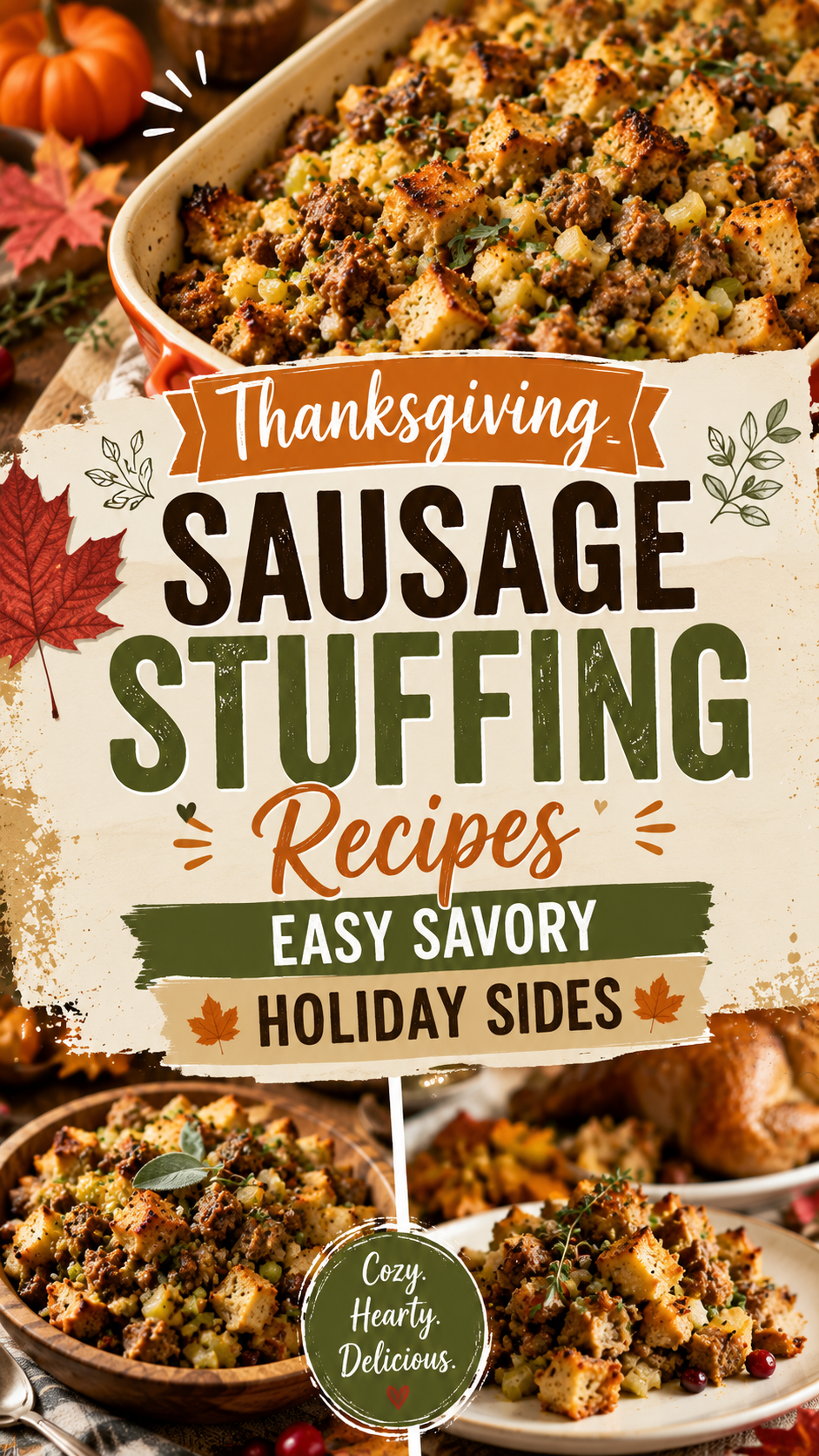
These five Thanksgiving sausage stuffing recipes give you classic, savory holiday flavor with a few different twists: traditional herb sausage stuffing, apple sausage stuffing, cornbread sausage stuffing, mushroom sausage stuffing, and cranberry pecan sausage stuffing.
Each one can be baked in a casserole dish, which makes holiday timing much easier.
No stuffing-related engineering inside the turkey required.
What You’ll Need
1. Classic Herb Sausage Stuffing
- 1 pound Italian sausage, casings removed if needed
- 12 cups day-old bread cubes
- 1 large yellow onion, diced
- 4 celery stalks, diced
- 4 tablespoons unsalted butter
- 3 garlic cloves, minced
- 2 teaspoons dried sage
- 1 teaspoon dried thyme
- 1 teaspoon dried rosemary
- 1/2 teaspoon black pepper
- 1 teaspoon salt, plus more as needed
- 2 1/2 to 3 cups low-sodium chicken broth
- 2 large eggs
- 1/4 cup chopped parsley
2. Apple Sausage Stuffing
- 1 pound mild Italian sausage
- 12 cups bread cubes
- 2 medium apples, diced
- 1 large onion, diced
- 3 celery stalks, diced
- 4 tablespoons unsalted butter
- 2 garlic cloves, minced
- 1 teaspoon dried sage
- 1 teaspoon dried thyme
- 1/2 teaspoon cinnamon
- 2 large eggs
- 2 1/2 cups chicken broth
- 1 teaspoon salt
- 1/2 teaspoon black pepper
3. Cornbread Sausage Stuffing
- 1 pound breakfast sausage or mild Italian sausage
- 8 cups crumbled cornbread
- 4 cups dried white bread cubes
- 1 large onion, diced
- 4 celery stalks, diced
- 4 tablespoons unsalted butter
- 3 garlic cloves, minced
- 2 teaspoons rubbed sage
- 1 teaspoon dried thyme
- 1/2 teaspoon black pepper
- 2 large eggs
- 2 1/2 to 3 cups chicken broth
- 1/4 cup chopped parsley
4. Mushroom Sausage Stuffing
- 1 pound Italian sausage
- 12 cups bread cubes
- 12 ounces cremini mushrooms, sliced
- 1 large onion, diced
- 3 celery stalks, diced
- 3 tablespoons unsalted butter
- 3 garlic cloves, minced
- 1 teaspoon dried thyme
- 1 teaspoon dried sage
- 1/2 teaspoon rosemary
- 2 large eggs
- 2 1/2 cups chicken broth
- 1 teaspoon salt
- 1/2 teaspoon black pepper
5. Cranberry Pecan Sausage Stuffing
- 1 pound mild Italian sausage
- 12 cups bread cubes
- 1 large onion, diced
- 3 celery stalks, diced
- 4 tablespoons unsalted butter
- 1 cup dried cranberries
- 3/4 cup chopped pecans
- 2 garlic cloves, minced
- 1 teaspoon dried sage
- 1 teaspoon dried thyme
- 2 large eggs
- 2 1/2 cups chicken broth
- 1 teaspoon salt
- 1/2 teaspoon black pepper
- 2 tablespoons chopped parsley
Tools You’ll Need
- Large skillet
- Large mixing bowl
- 9-by-13-inch baking dish
- Sharp knife
- Cutting board
- Measuring cups and spoons
- Wooden spoon or spatula
- Whisk
- Foil
- Food thermometer
A very large bowl helps.
Stuffing has a strange ability to expand beyond whatever bowl you originally chose for it.
At some point it becomes bread-based inventory management.
1. Classic Herb Sausage Stuffing
This is the one to make when you want Thanksgiving stuffing that tastes familiar.
Sage, thyme, rosemary, onion, celery, sausage, and toasted bread do most of the work.
Nothing unusual.
Nothing trying to become the main course.
Just good stuffing.
Dry the Bread
If your bread is already stale and dry, you’re set.
If not, spread the cubes across baking sheets.
Bake at 300°F for about 20 to 30 minutes, stirring once or twice, until dry but not deeply browned.
Cool.
Cook the Sausage
Heat a large skillet over medium heat.
Add the sausage.
Cook, breaking it into small pieces, until fully browned.
Pork sausage should reach 160°F.
Transfer to a large bowl.
Drain excess grease if necessary.
Cook the Vegetables
Add butter to the same skillet.
Add onion and celery.
Cook for 7 to 9 minutes, until softened.
Add garlic, sage, thyme, rosemary, salt, and pepper.
Cook for about 30 seconds.
Add the vegetables to the sausage.
Assemble
Add the dried bread and parsley.
Whisk eggs with 2 1/2 cups chicken broth.
Pour the mixture gradually over the bread while tossing gently.
Add extra broth a little at a time if needed.
The bread should feel evenly moistened without becoming soupy.
Bake
Heat the oven to 350°F.
Butter a 9-by-13-inch baking dish.
Transfer the stuffing to the dish.
Cover with foil.
Bake for 25 minutes.
Remove the foil and bake another 20 to 25 minutes, until the top is golden and the center reaches 165°F.
That crispy top layer will disappear faster than anyone admits.
2. Apple Sausage Stuffing
Apples bring a little sweetness without making the stuffing taste like dessert.
The trick is choosing firm apples that soften while still holding some shape.
Honeycrisp, Pink Lady, Braeburn, or Granny Smith all work well.
Brown the Sausage
Cook the sausage in a large skillet over medium heat until browned and it reaches 160°F.
Transfer to a bowl.
Cook the Apples and Vegetables
Melt butter in the skillet.
Add onion and celery.
Cook for about 5 minutes.
Add diced apples.
Cook for another 4 to 5 minutes.
The apples should begin to soften but should not turn into applesauce.
Add garlic, sage, thyme, cinnamon, salt, and pepper.
Cook for 30 seconds.
Mix the Stuffing
Add the cooked sausage, bread cubes, and apple mixture to a large bowl.
Whisk eggs and broth.
Pour over the bread gradually while tossing.
Start with less broth.
Add more only as needed.
Bread varieties absorb liquid differently.
Science enjoys making grocery shopping confusing.
Bake
Transfer to a greased 9-by-13-inch baking dish.
Cover with foil.
Bake at 350°F for 25 minutes.
Uncover.
Bake another 20 to 25 minutes, until golden and the center reaches 165°F.
Pro Tips for Better Sausage Stuffing
Use dry bread. Fresh soft bread absorbs broth too quickly and can become gummy.
Do not pour all the broth in at once. Add it gradually until the bread is moist but not swimming.
Cook the sausage before assembling. Raw sausage should not simply disappear into the casserole and hope everything works out.
Taste before adding extra salt. Sausage and broth can both be salty.
Bake uncovered at the end. This gives you the crisp top that makes baked stuffing worth making.
One more useful rule:
Do not mash everything together aggressively.
Toss gently.
Stuffing should have texture.
We are not manufacturing savory bread paste.
3. Cornbread Sausage Stuffing
Cornbread gives stuffing a slightly sweeter flavor and softer interior.
Using some white bread alongside it helps keep the texture from becoming too crumbly.
This version works especially well with breakfast sausage and plenty of sage.
Prepare the Bread
Use fully cooled cornbread.
Crumble it into fairly large pieces.
Combine it with the dried white bread cubes.
Do not turn the cornbread into crumbs.
You want visible pieces after baking.
Cook the Sausage
Brown the sausage in a large skillet over medium heat.
Cook to 160°F if using pork sausage.
Transfer to a large mixing bowl.
Cook the Vegetables
Add butter.
Cook onion and celery for about 7 to 8 minutes.
Add garlic, sage, thyme, and black pepper.
Cook for another 30 seconds.
Add the mixture to the sausage.
Assemble
Add cornbread, white bread, and parsley.
Whisk eggs with 2 1/2 cups broth.
Pour gradually over the stuffing.
Cornbread can absorb liquid quickly, so toss gently.
Add extra broth only if there are still dry areas.
Bake
Transfer to a buttered 9-by-13-inch dish.
Cover.
Bake at 350°F for 25 minutes.
Uncover and bake another 20 to 25 minutes, until golden and the center reaches 165°F.
Do not judge it immediately after baking.
Cornbread stuffing often firms up a little while resting.
Give it about 10 minutes before serving.
4. Mushroom Sausage Stuffing
This version leans more savory.
Mushrooms add deep flavor and help the stuffing feel rich without needing an unreasonable amount of butter.
The important part is browning them properly.
Cook the Sausage
Brown the sausage in a skillet until fully cooked.
Transfer to a large bowl.
Brown the Mushrooms
Add butter to the skillet.
Add the mushrooms in an even layer.
Cook for 7 to 10 minutes, stirring occasionally.
Let their moisture cook away.
You want browned mushrooms.
Not mushrooms sitting in a shallow hot bath reconsidering their life choices.
Add onion and celery.
Cook for another 5 minutes.
Add garlic, thyme, sage, rosemary, salt, and pepper.
Cook for 30 seconds.
Assemble
Add the vegetable mixture and bread cubes to the sausage.
Whisk eggs and broth.
Pour the liquid gradually over the bread while tossing gently.
Let the mixture sit for about 5 minutes.
Check the texture.
Add more broth if any large sections still feel dry.
Bake
Transfer to a greased baking dish.
Cover with foil.
Bake at 350°F for 25 minutes.
Uncover.
Bake another 20 to 25 minutes until the top is browned and the center reaches 165°F.
5. Cranberry Pecan Sausage Stuffing
This one has a little more holiday personality.
Dried cranberries bring tart sweetness.
Pecans add crunch.
Sausage keeps the whole thing firmly in savory side-dish territory.
It works especially well beside turkey and gravy.
Toast the Pecans
Spread the pecans on a baking sheet.
Toast at 350°F for about 6 to 8 minutes.
Cool.
Watch them carefully near the end.
Pecans can spend several minutes appearing completely uninterested in burning and then change their mind very quickly.
Cook the Sausage
Brown the sausage until fully cooked.
Transfer it to a large bowl.
Cook the Vegetables
Melt butter in the skillet.
Cook onion and celery for about 7 minutes.
Add garlic, sage, thyme, salt, and pepper.
Cook for 30 seconds.
Assemble
Add bread cubes, dried cranberries, toasted pecans, parsley, sausage, and vegetables to the bowl.
Whisk eggs with broth.
Pour the mixture slowly over the bread.
Toss gently.
Add only enough broth to moisten everything.
Bake
Transfer to a greased 9-by-13-inch dish.
Cover with foil.
Bake at 350°F for 25 minutes.
Remove the foil.
Bake for another 20 to 25 minutes, until crisp on top and 165°F in the center.
Which Thanksgiving Sausage Stuffing Should You Make?
| Stuffing | Flavor | Texture | Make-Ahead |
|---|---|---|---|
| Classic Herb | Traditional | Soft + crisp | Excellent |
| Apple Sausage | Sweet-savory | Moist | Excellent |
| Cornbread Sausage | Rich + slightly sweet | Softer | Excellent |
| Mushroom Sausage | Deep savory | Hearty | Excellent |
| Cranberry Pecan | Sweet-savory | Crunchy | Excellent |
For a traditional table, make the classic herb sausage stuffing.
For a slightly sweeter version, choose apple sausage stuffing.
For a Southern-inspired direction, go with cornbread sausage stuffing.
For savory flavor, make the mushroom version.
And if the table could use a little color and crunch, the cranberry pecan stuffing does the job nicely.
What Bread Works Best for Stuffing?
The best stuffing bread is sturdy enough to absorb broth without immediately collapsing.
Good choices include:
- French bread
- Italian bread
- Sourdough
- Country-style white bread
- Challah
- Cornbread
Avoid extremely soft sandwich bread unless it has been dried thoroughly.
Whatever bread you use, drying is important.
Fresh bread absorbs liquid unevenly.
Dry bread behaves more like a sponge and gives you better control.
Thanksgiving has enough unpredictable variables.
Bread does not need to join them.
Fresh Bread vs. Stale Bread
Stale bread is useful.
Properly dried bread is even better.
If your loaf is several days old, cube it and check the texture.
If the centers still feel soft, dry the cubes in the oven.
You want them dry throughout, not hard enough to injure the gravy boat.
Bake at 300°F until dry.
Cool before assembling the stuffing.
How Much Broth Should You Add?
This is the part of stuffing recipes where exact measurements can only take you so far.
Bread varies.
Cornbread varies.
Humidity varies.
How dry you made the cubes varies.
Start with about 2 to 2 1/2 cups broth for 12 cups bread.
Toss.
Wait a minute.
Then add more if necessary.
The stuffing should feel moist throughout, but liquid should not collect at the bottom of the bowl.
Too dry and it tastes like seasoned toast.
Too wet and it can become dense and gummy.
Nobody came to Thanksgiving hoping for bread pudding with sausage.
Sausage Options
Different sausages can change the entire stuffing.
Mild Italian Sausage
A very safe choice.
Savory without overwhelming the herbs.
Hot Italian Sausage
Adds a little heat.
Good if the rest of the menu is fairly mild.
Breakfast Sausage
Great with cornbread, sage, and apples.
Turkey Sausage
Works well if you want a leaner option.
Ground poultry sausage should reach 165°F.
Chicken Sausage
Also works, depending on flavor.
Again, poultry sausage should reach 165°F.
Avoid strongly flavored sausages unless they fit the rest of your Thanksgiving menu.
A stuffing aggressively flavored like fennel, jalapeño, maple, and smoked cheddar may technically be possible.
It may also have begun planning its own holiday.
Easy Substitutions and Variations
Apples: Pears can work in the apple stuffing.
Pecans: Use walnuts.
Dried cranberries: Dried cherries are another option.
Chicken broth: Turkey broth is excellent if available.
Fresh herbs: Use them if you have them. You’ll usually need more fresh herbs than dried.
White bread: Sourdough brings more tang.
Cornbread: Use homemade or a sturdy store-bought version.
Celery: Fennel can replace some of it for a slightly different flavor.
You can also add cooked chestnuts, leeks, or roasted squash.
Choose one or two extras.
Stuffing is not improved by treating the refrigerator door like a checklist.
Make-Ahead Thanksgiving Stuffing
This is where sausage stuffing becomes especially useful.
You can assemble most versions before Thanksgiving.
One Day Ahead
Cook the sausage.
Cook the vegetables.
Combine everything with the bread, eggs, and broth.
Transfer to the baking dish.
Cover tightly.
Refrigerate at 40°F or below.
Thanksgiving Day
Bake the stuffing straight from the refrigerator.
A cold casserole may need additional baking time.
Keep it covered at first so the top does not brown too early.
Most importantly, make sure the center reaches 165°F.
Do not simply trust the timer because the edges look hot.
Casseroles enjoy making people nervous for no reason.
A thermometer settles the argument.
Can You Prepare Stuffing Two Days Ahead?
Parts of it, yes.
Dry the bread two or three days ahead.
Chop vegetables a day or two ahead and refrigerate.
Cook the sausage ahead and refrigerate promptly.
For the best quality and simpler food-safety handling, fully assemble the egg-and-broth mixture closer to baking, usually the day before.
That keeps the bread from sitting wet for too long.
How to Get Crispy Stuffing on Top
The crisp top is often the favorite part.
For more of it:
Use a wide casserole dish rather than a very deep one.
Bake covered first.
Then remove the foil for the final 20 to 25 minutes.
You can also dot the top with a little butter before baking.
If you want extra crispy edges, divide the stuffing between two smaller dishes.
More surface area means more browned bits.
This is one of the rare holiday situations where dividing something creates less conflict.
What to Serve With Sausage Stuffing
Stuffing belongs beside the usual Thanksgiving favorites.
Try it with:
- Roast turkey
- Baked ham
- Mashed potatoes
- Turkey gravy
- Cranberry sauce
- Green beans
- Brussels sprouts
- Roasted carrots
- Sweet potatoes
If your stuffing contains apples or cranberries, a more savory vegetable side can help balance the meal.
If you’re serving mushroom stuffing, a fresh salad or bright cranberry sauce works well.
Not every item on the Thanksgiving plate needs butter, cream, cheese, gravy, or all four.
The salad has already been given enough responsibility.
How Much Stuffing Do You Need?
Plan on roughly 3/4 to 1 cup of stuffing per person when it is one of several Thanksgiving sides.
For 8 people, one 9-by-13-inch dish will usually be plenty.
For 12 or more, consider making a larger batch or two different stuffings.
That can also solve the annual debate between people who want traditional stuffing and people who believe cranberries belong everywhere.
Both groups can have a casserole.
Thanksgiving diplomacy achieved.
Stuffing vs. Dressing
The words are often used differently depending on region and family tradition.
Technically, stuffing may refer to a mixture cooked inside poultry, while dressing often refers to the same kind of dish baked separately.
In everyday holiday cooking, people use both terms.
These recipes are baked in casserole dishes.
That makes them easier to prepare, easier to portion, and easier to bring to a safe internal temperature.
Call them stuffing.
Call them dressing.
They will still disappear.
Food Safety for Sausage Stuffing
Stuffing contains several ingredients that need proper handling, including meat and eggs.
Cook pork sausage to 160°F before assembling.
Cook poultry sausage to 165°F.
Once assembled, bake the stuffing until the center reaches 165°F.
If preparing ahead, refrigerate promptly at 40°F or below.
Do not leave assembled stuffing sitting at room temperature while waiting for oven space.
After serving, refrigerate leftovers within 2 hours, or within 1 hour above 90°F.
If you do cook stuffing inside poultry, food-safety timing becomes more complicated because both the bird and the center of the stuffing must reach safe temperatures.
For a busy Thanksgiving, baking stuffing separately is usually much easier.
The turkey has enough responsibilities already.
Leftovers and Storage
Transfer leftover stuffing into shallow containers and refrigerate promptly.
Use within 3 to 4 days.
Reheat leftovers to 165°F.
For the oven, place stuffing in a baking dish and add a small splash of broth if it looks dry.
Cover with foil.
Warm at 350°F until heated through.
Remove the foil for the final few minutes if you want the top crispy again.
Stuffing can also be frozen.
Portion it into freezer-safe containers.
Thaw in the refrigerator before reheating.
Leftover stuffing is particularly good with:
- Turkey sandwiches
- Fried eggs
- Leftover gravy
- Roast chicken
You can also bake it in muffin cups for crispy individual portions.
Not every leftover needs a career change.
Stuffing just happens to be good at several jobs.
Frequently Asked Questions
What sausage is best for Thanksgiving stuffing?
Mild Italian sausage and breakfast sausage are both excellent choices. Use breakfast sausage for a stronger sage flavor and Italian sausage for a more savory herb profile.
Should sausage be cooked before adding it to stuffing?
Yes. Brown the sausage fully before mixing it with the bread and other ingredients.
What temperature should sausage stuffing reach?
The center of the baked stuffing should reach 165°F.
Can sausage stuffing be made the day before?
Yes. Assemble it, cover tightly, refrigerate, and bake the next day until the center reaches 165°F.
Why is my stuffing mushy?
Too much broth, bread that was not dry enough, or aggressive mixing can all make stuffing mushy.
Why is my stuffing dry?
It may need more broth, more fat, or less baking time. Add broth gradually during assembly until all the bread is evenly moist.
Can I use fresh bread for stuffing?
Yes, but dry it in the oven first for better texture.
What apples are good in sausage stuffing?
Firm varieties such as Honeycrisp, Pink Lady, Braeburn, and Granny Smith work well.
Can I make sausage stuffing without eggs?
Yes, though the texture may be looser. The eggs help bind the stuffing together.
Can sausage stuffing be frozen?
Yes. Cooked stuffing freezes well when cooled promptly and stored properly.
Wrapping Up
Sausage stuffing does not need to be complicated to earn a permanent place on the Thanksgiving table.
Make the classic herb version when you want familiar sage, onion, celery, and sausage flavor.
Try apple sausage stuffing when you want a little sweetness.
Choose cornbread sausage stuffing for a softer, richer side.
Make mushroom sausage stuffing when savory flavor is the priority.
Or bring out cranberry pecan sausage stuffing when the holiday table needs a little crunch and color.
Dry the bread properly.
Add the broth gradually.
Bake until the center reaches the right temperature.
Then protect the crispy corner pieces if those are your favorite.
Thanksgiving guests have very good instincts about where the best parts of the casserole are hiding.
If you make one of these stuffing recipes, leave a comment and tell me which version you tried, or drop any questions below.