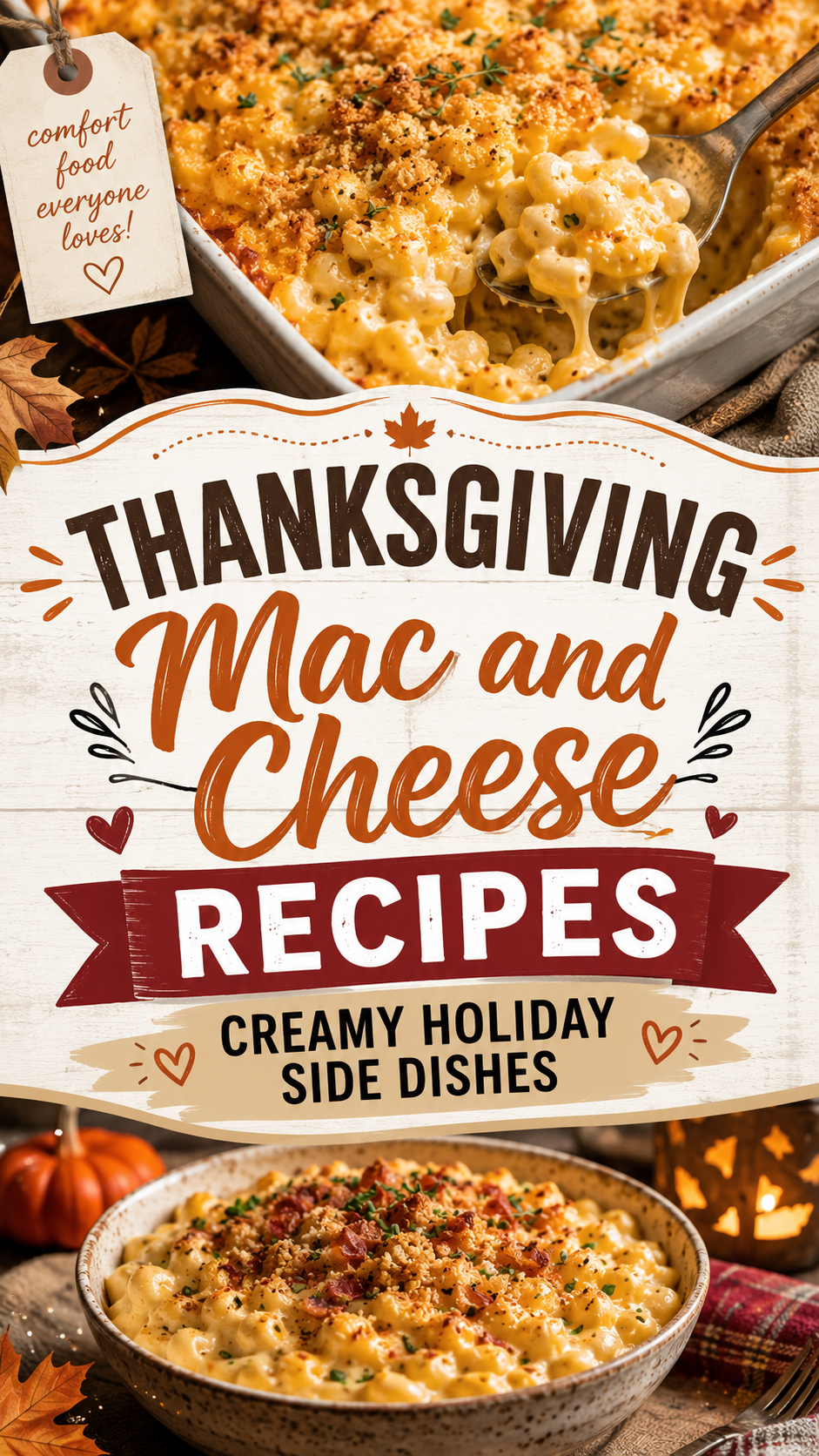
Mac and cheese is not always the first side dish people think of for Thanksgiving.
But once it appears on the table, nobody seems confused about what to do with it.
It fits right in beside turkey, stuffing, green beans, sweet potatoes, and rolls, especially when you want one extra comfort-food side that everyone recognizes.
The key is making mac and cheese creamy enough to feel special without turning it into a heavy block of pasta and cheese.
For these Thanksgiving mac and cheese recipes, we’re making classic baked mac and cheese, stovetop white cheddar mac and cheese, smoky gouda mac and cheese, broccoli cheddar mac and cheese, and bacon herb mac and cheese.
Some are better for baking ahead.
Some are faster on the stovetop.
All of them work well for a holiday table.
What You’ll Need
Classic Baked Mac and Cheese
- 1 pound elbow macaroni
- 4 tablespoons unsalted butter
- 1/4 cup all-purpose flour
- 3 cups whole milk
- 1 cup heavy cream
- 2 cups shredded sharp cheddar cheese
- 1 1/2 cups shredded Monterey Jack cheese
- 1/2 cup grated Parmesan cheese
- 1 teaspoon Dijon mustard
- 1/2 teaspoon garlic powder
- 1/2 teaspoon onion powder
- 1 teaspoon salt
- 1/2 teaspoon black pepper
For the topping:
- 1 cup panko breadcrumbs
- 2 tablespoons unsalted butter, melted
- 1/4 cup grated Parmesan cheese
White Cheddar Stovetop Mac and Cheese
- 1 pound cavatappi or elbow macaroni
- 4 tablespoons unsalted butter
- 3 tablespoons all-purpose flour
- 3 cups whole milk
- 8 ounces cream cheese, softened
- 2 1/2 cups shredded white cheddar cheese
- 1/2 teaspoon garlic powder
- 1 teaspoon Dijon mustard
- 3/4 teaspoon salt
- 1/4 teaspoon black pepper
- 2 tablespoons chopped fresh chives
Smoky Gouda Mac and Cheese
- 1 pound shell pasta
- 4 tablespoons unsalted butter
- 1/4 cup all-purpose flour
- 3 cups whole milk
- 1 cup heavy cream
- 2 cups shredded smoked Gouda cheese
- 1 1/2 cups shredded sharp cheddar cheese
- 1/2 teaspoon smoked paprika
- 1/2 teaspoon garlic powder
- 1/4 teaspoon ground mustard
- 3/4 teaspoon salt
- 1/4 teaspoon black pepper
For the topping:
- 3/4 cup panko breadcrumbs
- 2 tablespoons unsalted butter, melted
- 1/2 teaspoon smoked paprika
Broccoli Cheddar Mac and Cheese
- 1 pound elbow macaroni
- 3 cups small broccoli florets
- 4 tablespoons unsalted butter
- 1/4 cup all-purpose flour
- 3 cups whole milk
- 1 cup heavy cream
- 3 cups shredded sharp cheddar cheese
- 1/2 cup grated Parmesan cheese
- 1/2 teaspoon garlic powder
- 1/2 teaspoon onion powder
- 3/4 teaspoon salt
- 1/4 teaspoon black pepper
Bacon Herb Mac and Cheese
- 1 pound cavatappi pasta
- 8 slices bacon, chopped
- 3 tablespoons unsalted butter
- 1/4 cup all-purpose flour
- 3 cups whole milk
- 1 cup heavy cream
- 2 cups shredded sharp cheddar cheese
- 1 cup shredded Gruyère cheese
- 1 teaspoon fresh thyme leaves
- 1 teaspoon finely chopped fresh rosemary
- 1/2 teaspoon garlic powder
- 3/4 teaspoon salt
- 1/4 teaspoon black pepper
- 2 tablespoons chopped fresh parsley
Tools You’ll Need
You don’t need anything unusual for these recipes.
- Large stockpot
- Large saucepan
- Large skillet
- Colander
- 9×13-inch baking dish
- Large mixing bowl
- Medium mixing bowls
- Whisk
- Wooden spoon
- Rubber spatula
- Chef’s knife
- Cutting board
- Measuring cups and spoons
- Cheese grater
- Serving spoon
- Aluminum foil
1. Classic Baked Mac and Cheese
This is the version to make when you want the full holiday treatment.
Creamy underneath.
Golden on top.
Enough cheese to feel special.
Preheat the oven to 375°F.
Bring a large pot of salted water to a boil.
Cook the macaroni until just shy of al dente.
Usually that means about 1 to 2 minutes less than the package directions.
Drain.
Do not overcook the pasta here because it will continue cooking in the oven.
Make the Cheese Sauce
Melt the butter in a large saucepan over medium heat.
Whisk in the flour.
Cook for about 1 to 2 minutes.
Slowly pour in the milk while whisking.
Add the heavy cream.
Cook gently until the mixture thickens enough to coat a spoon.
Reduce the heat to low.
Add the cheddar, Monterey Jack, and Parmesan a little at a time.
Stir until smooth.
Add Dijon mustard, garlic powder, onion powder, salt, and black pepper.
Taste.
Adjust seasoning if needed.
Add the cooked pasta.
Stir gently until every piece is coated.
Transfer to a greased 9×13-inch baking dish.
Add the Topping
Mix the panko, melted butter, and Parmesan.
Sprinkle evenly over the pasta.
Bake for about 20 to 25 minutes.
The edges should be bubbling and the top lightly golden.
Let it rest for 5 to 10 minutes before serving.
That short rest gives the sauce time to settle around the pasta.
And yes, someone will try to scoop it immediately anyway.
Thanksgiving has traditions.
2. White Cheddar Stovetop Mac and Cheese
This is the mac and cheese to make when the oven is already booked.
No baking dish.
No breadcrumb topping.
Just very creamy pasta straight from the stovetop.
Cook the pasta in salted water until al dente.
Drain.
Melt the butter in a large saucepan.
Whisk in the flour.
Cook for about 1 minute.
Gradually whisk in the milk.
Cook over medium heat until slightly thickened.
Reduce the heat.
Add the cream cheese.
Stir until smooth.
Add the white cheddar a handful at a time.
Stir until melted.
Add garlic powder, Dijon mustard, salt, and black pepper.
Return the pasta to the saucepan.
Stir until coated.
Finish with fresh chives.
Serve immediately.
This version should stay loose and creamy.
If it sits too long and thickens, stir in a splash of warm milk.
Do not keep cooking it to “fix” the texture.
More heat usually makes cheese sauce tighter, not creamier.
Pro Tips for Creamier Mac and Cheese
Shred your own cheese when possible. Pre-shredded cheese often contains anti-caking ingredients that can make sauce less smooth.
Cook pasta slightly under al dente for baked recipes. It continues cooking in the oven.
Keep the heat low when adding cheese. High heat can make cheese sauces grainy.
Save a little warm milk. It is useful for loosening mac and cheese before serving.
Season the sauce before adding the pasta. Pasta absorbs flavor, so the sauce should taste slightly more seasoned on its own.
3. Smoky Gouda Mac and Cheese
Smoked Gouda gives mac and cheese a deeper flavor without requiring a long ingredient list.
It tastes rich.
A little smoky.
And slightly more grown-up than standard cheddar.
Preheat the oven to 375°F.
Cook the shell pasta until just shy of al dente.
Drain.
Melt the butter in a large saucepan.
Whisk in the flour.
Cook for about 1 minute.
Slowly whisk in the milk and heavy cream.
Cook until slightly thickened.
Reduce the heat.
Add smoked Gouda and cheddar gradually.
Stir until smooth.
Add smoked paprika, garlic powder, ground mustard, salt, and black pepper.
Add the pasta.
Stir well.
Transfer to a greased baking dish.
Mix the panko with melted butter and smoked paprika.
Sprinkle over the top.
Bake for approximately 20 to 25 minutes.
Let it rest briefly before serving.
This version works especially well if your Thanksgiving menu includes:
- Roast turkey
- Ham
- Green beans
- Brussels sprouts
- Savory stuffing
If your table already has several smoky dishes, use the classic or white cheddar version instead.
There can, in fact, be too much smoked paprika in one room.
4. Broccoli Cheddar Mac and Cheese
Sometimes putting a vegetable into mac and cheese is enough to make everyone feel responsible.
We’ll take it.
Bring a large pot of salted water to a boil.
Cook the pasta until almost al dente.
During the final 2 to 3 minutes, add the broccoli florets.
Drain everything together.
Set aside.
Preheat the oven to 375°F.
Melt the butter in a large saucepan.
Whisk in the flour.
Cook for about 1 minute.
Gradually whisk in the milk and cream.
Cook until slightly thickened.
Reduce the heat.
Add cheddar and Parmesan gradually.
Stir until smooth.
Season with garlic powder, onion powder, salt, and black pepper.
Add the pasta and broccoli.
Fold everything together gently.
Transfer to a baking dish.
Bake for about 20 minutes, until bubbling around the edges.
If you want a browned top, sprinkle on a little extra cheese during the final 5 minutes.
This is particularly useful if your Thanksgiving menu is short on vegetables.
No, broccoli covered in cheese does not suddenly become a salad.
But it’s trying.
5. Bacon Herb Mac and Cheese
This one is rich enough to feel very Thanksgiving.
Bacon brings salt and smoke.
Gruyère gives the sauce a deeper flavor.
Fresh herbs pull it back toward the holiday table.
Cook the bacon in a large skillet until crisp.
Transfer to a paper towel-lined plate.
Reserve about 1 tablespoon bacon fat.
Cook the pasta until just shy of al dente.
Drain.
Preheat the oven to 375°F.
Melt the butter with the reserved bacon fat in a large saucepan.
Whisk in the flour.
Cook for 1 to 2 minutes.
Gradually whisk in the milk and heavy cream.
Cook until the sauce starts to thicken.
Reduce the heat.
Add cheddar and Gruyère gradually.
Stir until smooth.
Add thyme, rosemary, garlic powder, salt, and black pepper.
Stir in most of the bacon.
Add the pasta.
Mix until coated.
Transfer to a baking dish.
Sprinkle the remaining bacon over the top.
Bake for approximately 20 to 25 minutes.
Finish with parsley.
This mac and cheese has plenty going on.
It does not need six additional toppings.
Put the fried onions down.
They have other Thanksgiving responsibilities.
Which Thanksgiving Mac and Cheese Should You Make?
You probably only need one.
Unless you’re hosting an unusually passionate mac and cheese family.
| Recipe | Flavor | Texture | Best Feature |
|---|---|---|---|
| Classic baked | Cheesy, traditional | Creamy with crisp top | Crowd favorite |
| White cheddar | Rich, mild | Extra creamy | No oven needed |
| Smoky Gouda | Smoky, savory | Creamy with crisp top | Stronger flavor |
| Broccoli cheddar | Cheesy, savory | Creamy | Adds vegetables |
| Bacon herb | Savory, herby | Rich and creamy | Holiday flavor |
For a traditional Thanksgiving table, classic baked mac and cheese is the safest choice.
If oven space is the problem, make white cheddar stovetop mac.
For something more flavorful, choose smoky Gouda.
Broccoli cheddar is useful when you want mac and cheese to double as a vegetable side.
Sort of.
And bacon herb works well with a simple turkey and lighter vegetable sides.
How to Keep Mac and Cheese Creamy
This is the part that matters most.
Nobody wants dry Thanksgiving mac and cheese.
Start by using enough sauce.
Pasta keeps absorbing liquid while it sits and bakes.
That means the mixture should look slightly looser than you think it needs to when it goes into the baking dish.
Also:
- Don’t overcook the pasta before baking.
- Don’t bake longer than necessary.
- Add cheese over low heat.
- Use whole milk or a combination of milk and cream.
- Keep the casserole covered during reheating.
- Add a splash of milk before reheating leftovers.
Mac and cheese usually dries out because it has been cooked too long, not because it needed more cheese.
Adding another pound of cheddar cannot fix everything.
A difficult lesson.
Best Cheeses for Thanksgiving Mac and Cheese
Cheddar is the obvious starting point.
But combining cheeses usually gives better flavor and texture.
Sharp Cheddar
Strong flavor and good melting ability.
Excellent as the main cheese.
Monterey Jack
Mild and very melty.
Useful for making cheddar-based sauces smoother.
Gruyère
Nutty and savory.
Pairs especially well with herbs, bacon, and Thanksgiving foods.
Gouda
Creamy and slightly sweet.
Smoked Gouda adds a stronger smoky flavor.
Parmesan
Salty and savory.
Best used in smaller amounts rather than as the main melting cheese.
Cream Cheese
Adds extra creaminess.
Especially useful in stovetop versions.
A good holiday mac and cheese often uses two or three cheeses, not eight.
We’re making dinner.
Not emptying the cheese drawer.
What Pasta Shape Works Best?
Elbow macaroni is traditional for a reason.
It holds sauce well and fits easily on a crowded holiday plate.
Other good choices include:
- Cavatappi
- Small shells
- Medium shells
- Gemelli
- Short rigatoni
Look for a pasta with curves, ridges, or hollow spaces.
Those shapes catch more cheese sauce.
Long pasta like spaghetti technically works.
It simply turns mac and cheese into a completely different eating experience.
And nobody needs to be twirling cheesy noodles around a fork beside Thanksgiving gravy.
Make-Ahead Thanksgiving Mac and Cheese
Mac and cheese can be made ahead.
It just needs a little care so it doesn’t dry out.
One Day Before
For baked versions:
Cook the pasta slightly firmer than usual.
Make the cheese sauce.
Combine everything.
Transfer to the baking dish.
Do not bake yet.
Cover tightly.
Refrigerate.
Keep breadcrumb toppings separate.
Thanksgiving Day
Take the casserole from the refrigerator while the oven preheats.
Add the topping.
Bake at 375°F until hot and bubbling.
A chilled casserole may require extra baking time.
If the top browns too quickly before the center is hot, cover loosely with foil.
Heat leftovers or make-ahead casseroles to 165°F in the center.
For stovetop mac and cheese, making it shortly before dinner gives the best texture.
You can grate the cheese and measure ingredients ahead to make the final cooking much faster.
How Much Mac and Cheese Do You Need?
Thanksgiving portions are different from regular dinner portions.
People are choosing from several sides.
As a side dish, plan roughly 1/2 to 3/4 cup of cooked mac and cheese per guest.
For 8 people, one standard 9×13-inch casserole is usually plenty when several other sides are available.
For 12 to 16 people, consider making a larger batch or two casseroles.
If you’re serving children, mac and cheese may disappear faster than the vegetables.
This is not insider information.
Anyone who has met a child could probably have predicted it.
How to Build a Good Thanksgiving Side-Dish Balance
Mac and cheese is rich.
That means the dishes around it matter.
If you’re serving:
- Mac and cheese
- Mashed potatoes
- Sweet potato casserole
- Corn casserole
- Creamed spinach
you may have accidentally created an entire table of soft, creamy food.
Delicious.
But a little one-note.
Balance mac and cheese with sides such as:
- Roasted Brussels sprouts
- Green beans
- Fresh salad
- Cranberry sauce
- Roasted carrots
- Broccoli
- Tangy slaw
Acidity, crunch, and fresh vegetables make the whole meal more interesting.
And give people somewhere to put the gravy besides another creamy carbohydrate.
Substitutions and Variations
Elbow macaroni: Use cavatappi, shells, or another short pasta.
Whole milk: Use 2% milk, though the sauce will be slightly less rich.
Heavy cream: Use additional whole milk for a lighter sauce.
Sharp cheddar: Use medium cheddar if you prefer milder flavor.
Monterey Jack: Use mozzarella or mild Gouda.
Gruyère: Swiss cheese can work, though the flavor will differ.
Panko: Use regular breadcrumbs.
Broccoli: Cauliflower works in the broccoli cheddar version.
Bacon: Leave it out for a meatless dish.
Fresh herbs: Use smaller amounts of dried herbs when needed.
For vegetarian mac and cheese, choose cheeses made according to your dietary needs and omit bacon.
For gluten-free versions, use suitable gluten-free pasta, flour, and breadcrumbs.
Can You Make Mac and Cheese in a Slow Cooker?
Yes, but the texture is different.
Slow cookers are more useful for holding cooked mac and cheese warm than for producing the best baked-style result.
If you transfer fully cooked mac and cheese to a slow cooker, use the WARM setting and keep the food at 140°F or above.
Stir occasionally.
Add a splash of warm milk if it starts thickening too much.
Do not keep it sitting on high heat for hours.
Cheese sauce has limits.
Even on Thanksgiving.
What to Serve With Thanksgiving Mac and Cheese
Mac and cheese fits especially well beside:
- Roast turkey
- Turkey breast
- Glazed ham
- Green beans
- Brussels sprouts
- Cranberry sauce
- Stuffing
- Roasted carrots
- Thanksgiving salad
- Corn
- Dinner rolls
- Gravy
If you’re making smoky Gouda or bacon mac and cheese, keep some of the other sides simpler.
Classic mac and cheese is easier to pair with nearly everything.
Leftovers and Storage
Refrigerate mac and cheese within 2 hours of serving.
Store it in an airtight container.
Use within 3 to 4 days.
Reheat leftovers to 165°F.
For individual portions, add a small splash of milk before reheating.
For a larger casserole, place it in a baking dish, add a little milk, cover with foil, and reheat in the oven until hot.
Remove the foil for the final few minutes if you want to refresh the topping.
Leftover mac and cheese can also become:
- Fried mac and cheese bites
- Turkey mac and cheese
- Broccoli mac casserole
- Buffalo chicken mac
- Stuffed peppers
Or you can simply reheat a bowl the next day.
Nobody requires Thanksgiving leftovers to become a new personality every time.
Frequently Asked Questions
Can I make Thanksgiving mac and cheese the day before?
Yes. Assemble baked mac and cheese, cover it, refrigerate, and bake it on Thanksgiving Day. Keep breadcrumb toppings separate until baking.
How do I keep baked mac and cheese creamy?
Use plenty of sauce, slightly undercook the pasta, avoid overbaking, and add cheese over low heat.
What cheese is best for mac and cheese?
Sharp cheddar is an excellent base. Combining it with Monterey Jack, Gruyère, Gouda, or Parmesan can add better melt and flavor.
Why is my cheese sauce grainy?
The heat may have been too high when the cheese was added. Reduce the heat before stirring cheese into the sauce.
Can I use pre-shredded cheese?
Yes, but freshly shredded cheese usually melts more smoothly.
How much mac and cheese should I make per person?
Around 1/2 to 3/4 cup per guest is a useful Thanksgiving side-dish portion.
Can mac and cheese be kept warm in a slow cooker?
Yes. Transfer fully cooked mac and cheese to the slow cooker and use WARM while maintaining at least 140°F.
Can I freeze mac and cheese?
Yes. Baked mac and cheese can be frozen, though the sauce may be slightly less creamy after thawing and reheating.
What vegetables can I add to mac and cheese?
Broccoli, cauliflower, spinach, peas, or roasted Brussels sprouts can all work depending on the recipe.
What goes well with mac and cheese for Thanksgiving?
Turkey, ham, green vegetables, cranberry sauce, roasted vegetables, and salads all balance its creamy richness.
Wrapping Up
Thanksgiving mac and cheese has one job.
Be creamy.
Everything after that is personal preference.
Make classic baked mac and cheese for the familiar golden-topped version.
Choose white cheddar stovetop mac when oven space is disappearing.
Use smoked Gouda when you want deeper flavor.
Add broccoli and cheddar for a little vegetable backup.
Or go with bacon, Gruyère, and herbs for something especially rich and savory.
Whichever one you choose, keep the sauce loose, don’t overcook the pasta, and take the casserole out before it dries out.
Because nobody at Thanksgiving has ever complained that the mac and cheese was too creamy.