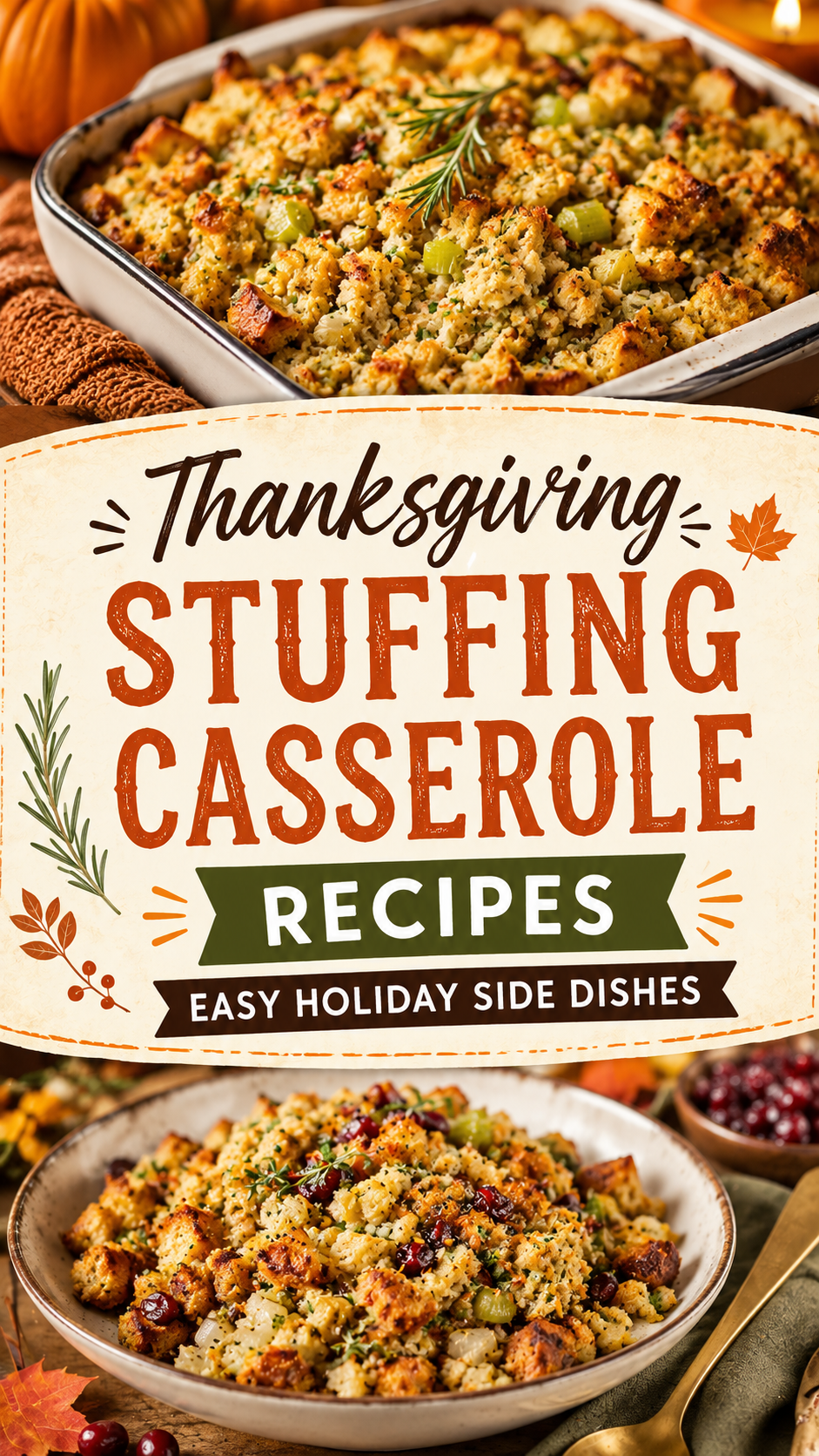
Stuffing is already one of the most comforting parts of Thanksgiving dinner.
Turn it into a casserole and it gets even more useful.
You get crispy golden edges, a soft savory center, plenty of herbs, and a dish that can usually be assembled before the holiday rush begins.
A good Thanksgiving stuffing casserole should be moist without becoming soggy, crisp across the top, and flavorful enough that gravy feels optional rather than necessary for rescue.
For these Thanksgiving stuffing casserole recipes, we’re making classic herb stuffing casserole, sausage apple stuffing casserole, cranberry pecan stuffing casserole, chicken and stuffing casserole, and cheesy broccoli stuffing casserole.
Some stay close to the traditional Thanksgiving table.
Others turn stuffing into something a little more substantial.
All five are built for sharing.
What You’ll Need
Classic Herb Stuffing Casserole
- 10 cups cubed day-old bread
- 6 tablespoons unsalted butter
- 1 large yellow onion, diced
- 4 celery stalks, diced
- 3 garlic cloves, minced
- 2 teaspoons dried sage
- 1 teaspoon dried thyme
- 1 teaspoon dried rosemary
- 1 teaspoon salt
- 1/2 teaspoon black pepper
- 2 1/2 cups chicken or turkey broth
- 2 large eggs
- 1/3 cup chopped fresh parsley
- 2 tablespoons melted butter, for the top
Sausage Apple Stuffing Casserole
- 10 cups cubed day-old bread
- 1 pound breakfast sausage
- 4 tablespoons unsalted butter
- 1 large yellow onion, diced
- 3 celery stalks, diced
- 2 medium apples, peeled and diced
- 3 garlic cloves, minced
- 2 teaspoons dried sage
- 1 teaspoon dried thyme
- 1/2 teaspoon dried rosemary
- 3/4 teaspoon salt
- 1/2 teaspoon black pepper
- 2 1/4 cups chicken broth
- 2 large eggs
- 1/4 cup chopped fresh parsley
Cranberry Pecan Stuffing Casserole
- 10 cups cubed day-old bread
- 5 tablespoons unsalted butter
- 1 large yellow onion, diced
- 3 celery stalks, diced
- 3 garlic cloves, minced
- 1 teaspoon dried sage
- 1 teaspoon dried thyme
- 1/2 teaspoon dried rosemary
- 3/4 teaspoon salt
- 1/4 teaspoon black pepper
- 2 1/4 cups vegetable or chicken broth
- 2 large eggs
- 3/4 cup dried cranberries
- 3/4 cup chopped pecans
- 1/4 cup chopped fresh parsley
Chicken and Stuffing Casserole
- 4 cups cooked shredded chicken
- 8 cups cubed day-old bread
- 4 tablespoons unsalted butter
- 1 medium yellow onion, diced
- 3 celery stalks, diced
- 2 garlic cloves, minced
- 1 teaspoon dried sage
- 1 teaspoon dried thyme
- 1/2 teaspoon salt
- 1/4 teaspoon black pepper
- 2 cups chicken broth
- 2 large eggs
- 1 cup sour cream
- 1/2 cup whole milk
- 1/4 cup chopped fresh parsley
- 2 tablespoons melted butter
Cheesy Broccoli Stuffing Casserole
- 8 cups cubed day-old bread
- 3 cups small broccoli florets
- 4 tablespoons unsalted butter
- 1 medium yellow onion, diced
- 2 garlic cloves, minced
- 3 tablespoons all-purpose flour
- 2 cups whole milk
- 1 cup vegetable or chicken broth
- 1 teaspoon Dijon mustard
- 1/2 teaspoon dried thyme
- 3/4 teaspoon salt
- 1/4 teaspoon black pepper
- 2 cups shredded sharp cheddar cheese
- 2 large eggs
- 1/2 cup grated Parmesan cheese
Tools You’ll Need
You don’t need special equipment for stuffing casserole.
A large bowl and a baking dish do most of the work.
You’ll also need:
- 9×13-inch baking dishes
- Large mixing bowls
- Large skillet
- Medium saucepan
- Whisk
- Wooden spoon
- Rubber spatula
- Chef’s knife
- Cutting board
- Measuring cups and spoons
- Aluminum foil
- Instant-read thermometer
- Serving spoon
1. Classic Herb Stuffing Casserole
This is the one to make when nobody wants Thanksgiving stuffing reinvented.
Bread.
Butter.
Onion.
Celery.
Sage.
Crispy top.
Done properly, that’s plenty.
Preheat the oven to 375°F.
Grease a 9×13-inch baking dish.
Place the bread cubes in a large mixing bowl.
Cook the Vegetables
Melt the butter in a large skillet over medium heat.
Add the onion and celery.
Cook for 6 to 8 minutes, until softened.
Add the garlic.
Cook for another 30 seconds.
Stir in sage, thyme, rosemary, salt, and black pepper.
Cook for about 30 seconds to wake up the herbs.
Pour the vegetable mixture over the bread.
Add the parsley.
Add the Broth
Whisk the broth and eggs together in a separate bowl.
Pour about three-quarters of the mixture over the bread.
Fold gently.
Add more as needed.
The bread should feel thoroughly moistened without liquid collecting at the bottom of the bowl.
Different breads absorb different amounts of broth, so don’t automatically pour everything in at once.
Transfer to the baking dish.
Drizzle with melted butter.
Cover with foil.
Bake for 25 minutes.
Remove the foil.
Bake for another 20 to 25 minutes, until the top is crisp and the center reaches 165°F.
Let it rest for about 10 minutes.
That gives the casserole time to settle while everyone figures out where the gravy ended up.
2. Sausage Apple Stuffing Casserole
Sausage gives stuffing plenty of savory flavor.
Apple brings just enough sweetness to cut through it.
The result feels traditional without tasting exactly like every other pan of stuffing on the table.
Preheat the oven to 375°F.
Place the bread cubes in a large bowl.
Cook the sausage in a large skillet over medium heat, breaking it into small pieces.
Cook thoroughly.
Transfer the sausage to the bowl with the bread.
Drain excess fat if necessary.
Melt the butter in the same skillet.
Add onion and celery.
Cook for about 5 minutes.
Add the diced apples.
Cook for another 3 to 4 minutes.
You want them slightly softened, not turned into applesauce.
Add garlic, sage, thyme, rosemary, salt, and black pepper.
Cook for 30 seconds.
Transfer everything to the bread mixture.
Add parsley.
Whisk broth and eggs together.
Pour gradually over the bread while gently folding.
Transfer to a greased 9×13-inch baking dish.
Cover with foil.
Bake for 25 minutes.
Uncover.
Bake for another 20 to 25 minutes.
The center should reach 165°F.
Let rest briefly before serving.
For the apples, Granny Smith gives you more tartness.
Honeycrisp gives you a sweeter result.
Both work.
The stuffing isn’t particularly judgmental about apple varieties.
Pro Tips for Better Stuffing Casseroles
Start with dry bread. Fresh soft bread absorbs liquid unevenly and can become gummy.
Add broth gradually. You can always add another splash. Removing broth from soggy bread is considerably less practical.
Don’t crush the bread while mixing. Fold gently so you keep some texture.
Cover first, uncover later. The covered portion helps the center stay moist. Uncovering gives you those crisp edges.
Check the center with a thermometer. Stuffing casseroles containing eggs, meat, or poultry should reach 165°F.
3. Cranberry Pecan Stuffing Casserole
This version has the Thanksgiving colors working in its favor.
Cranberries add little sweet-tart bites.
Pecans bring crunch.
Herbs keep the whole thing firmly in savory-side territory.
Preheat the oven to 375°F.
Spread the pecans on a baking sheet.
Toast for about 5 to 7 minutes, watching closely.
Set aside.
Place the bread cubes in a large mixing bowl.
Melt the butter in a skillet.
Add onion and celery.
Cook for 6 to 8 minutes.
Add garlic, sage, thyme, rosemary, salt, and black pepper.
Cook for another 30 seconds.
Pour over the bread.
Add dried cranberries, about two-thirds of the toasted pecans, and parsley.
Whisk broth and eggs together.
Add the liquid gradually while folding the bread mixture.
Transfer to a greased baking dish.
Cover with foil.
Bake for 25 minutes.
Uncover.
Bake for another 20 minutes.
Sprinkle the remaining pecans over the top.
Bake for another 5 minutes, until the casserole is hot and crisp across the surface.
Check that the center reaches 165°F.
Saving some pecans until the end gives you better crunch.
Putting every nut into wet stuffing from the beginning rather defeats the point of inviting them.
4. Chicken and Stuffing Casserole
This one moves beyond a standard side dish.
With chicken, creamy filling, and stuffing together, it can work as a hearty Thanksgiving casserole or an easy meal for the days around the holiday.
It is also useful when you’re hosting a smaller gathering and don’t want to roast another large bird.
Preheat the oven to 375°F.
Place the bread cubes in a large bowl.
Melt the butter in a skillet.
Add onion and celery.
Cook for 6 to 8 minutes.
Add garlic, sage, thyme, salt, and black pepper.
Cook for another 30 seconds.
Add the vegetables to the bread.
Fold in the cooked chicken and parsley.
In another bowl, whisk together broth, eggs, sour cream, and milk.
Pour gradually over the bread mixture.
Fold until evenly moistened.
Transfer to a greased 9×13-inch baking dish.
Drizzle melted butter over the top.
Cover with foil.
Bake for 25 minutes.
Remove the foil.
Continue baking for 20 to 25 minutes, until golden and the center reaches 165°F.
Let stand for about 10 minutes.
Use chicken that is already fully cooked.
Rotisserie chicken can make this considerably faster.
If you’re using Thanksgiving leftovers, cooked turkey works too.
That substitution practically makes itself.
5. Cheesy Broccoli Stuffing Casserole
Stuffing and cheese are not the most traditional Thanksgiving partnership.
They get along surprisingly well.
Broccoli keeps this casserole from becoming nothing but bread covered in cheddar.
Which is probably useful.
Preheat the oven to 375°F.
Grease a 9×13-inch baking dish.
Bring a pot of water to a boil.
Add the broccoli.
Cook for about 2 minutes.
Drain thoroughly.
Place the bread cubes and broccoli in a large mixing bowl.
Make the Cheese Sauce
Melt the butter in a saucepan.
Add the onion.
Cook for 4 to 5 minutes.
Add garlic.
Cook for 30 seconds.
Sprinkle in the flour.
Whisk for about 1 minute.
Gradually add the milk.
Then add the broth.
Whisk until smooth.
Cook for several minutes until slightly thickened.
Stir in Dijon mustard, thyme, salt, and black pepper.
Reduce the heat.
Add the cheddar.
Stir until melted.
Let the sauce cool for a few minutes.
Whisk the eggs in a separate bowl.
Gradually whisk a little warm sauce into the eggs.
Then stir the egg mixture back into the remaining sauce.
Pour over the bread and broccoli.
Fold gently.
Transfer to the baking dish.
Sprinkle Parmesan over the top.
Cover.
Bake for 25 minutes.
Uncover and bake for another 20 to 25 minutes.
The center should reach 165°F.
Let rest before serving.
This casserole is rich.
Serve smaller portions and let it share the plate with something fresh.
Thanksgiving already has enough foods competing for the title of “creamiest thing here.”
Which Stuffing Casserole Should You Make?
The rest of your menu can make the decision easier.
| Recipe | Main Flavor | Texture | Best For |
|---|---|---|---|
| Classic herb | Traditional, savory | Moist with crisp top | Classic Thanksgiving |
| Sausage apple | Savory, slightly sweet | Hearty | Turkey dinners |
| Cranberry pecan | Sweet-savory, nutty | Moist and crunchy | Holiday gatherings |
| Chicken and stuffing | Rich and savory | Creamy, hearty | Smaller dinners |
| Cheesy broccoli | Cheesy and savory | Creamy | Comfort-food menus |
If turkey is already the star, classic herb stuffing is hard to beat.
For stronger flavor, choose sausage apple.
Cranberry pecan is a good option when you want something unmistakably holiday-like.
Chicken stuffing casserole works when you need something closer to a main dish.
Cheesy broccoli is for the table that has accepted Thanksgiving is not the day to fear cheese.
What Bread Is Best for Stuffing Casserole?
The bread matters more than people sometimes expect.
You need something sturdy enough to absorb broth without dissolving.
Good options include:
- French bread
- Italian bread
- Sourdough
- White sandwich bread
- Whole wheat bread
- Cornbread
- Brioche, used carefully
French or Italian bread gives you a reliable classic texture.
Sourdough adds more flavor.
Brioche creates richer stuffing but can become soft quickly, so use less liquid at first.
Cornbread produces a more crumbly casserole.
You can also combine breads.
Half sourdough and half French bread works very well.
Stuffing is one of the rare places where slightly stale bread walks into the kitchen and suddenly has excellent career prospects.
How to Dry Bread for Stuffing
Day-old bread is ideal.
Cut it into roughly 3/4-inch cubes and leave it uncovered for several hours or overnight.
If your bread is fresh, use the oven.
Spread the cubes over baking sheets.
Bake at 275°F to 300°F for about 25 to 40 minutes, stirring occasionally.
You want the bread dry.
Not deeply toasted.
Let it cool before making the stuffing.
Dry bread absorbs broth more predictably.
Fresh bread tends to compress and become gummy.
That small prep step makes a noticeable difference.
How Wet Should Stuffing Be Before Baking?
This is where many stuffing problems begin.
Before baking, the bread should feel thoroughly moist.
Pick up a piece.
It should be soft enough to compress slightly but not disintegrate in your hand.
There should not be a puddle of broth at the bottom of the bowl.
Start with less liquid than you think you’ll need.
Wait a minute.
Fold again.
Then decide if you need more.
Bread can continue absorbing liquid as it sits.
The exact amount of broth depends on how dry your bread is and what kind you’re using.
That is why the recipes give you a useful starting point rather than a reason to empty the entire carton without looking.
How to Get Crispy Stuffing on Top
Cover the casserole during the first part of baking.
That traps moisture and helps heat the center.
Then remove the foil.
The exposed surface begins drying and browning.
A little melted butter over the top also helps.
For even more crunch, spread the stuffing in a slightly larger, shallower baking dish.
More surface area means more crispy pieces.
Deep casserole dishes give you more soft center.
Neither is wrong.
This is mostly a question of whether your family fights over the crunchy pieces.
If they do, maximize surface area and improve Thanksgiving diplomacy.
Make-Ahead Thanksgiving Stuffing Casseroles
Stuffing casserole is particularly useful because much of the preparation can happen early.
Two Days Before
You can:
- Cube and dry the bread
- Chop onions
- Chop celery
- Toast nuts
- Measure dried herbs
Store the vegetables refrigerated.
Keep dried bread covered at room temperature once completely cool.
One Day Before
For casseroles without raw meat, you can prepare many components ahead.
For the safest and best texture, keep the dry bread and cooked vegetable mixture separate from the broth-and-egg mixture until closer to baking, or assemble the casserole and refrigerate it promptly.
If assembling ahead, cover tightly and refrigerate at 40°F or below.
Thanksgiving Day
Take the refrigerated casserole out while the oven preheats.
Bake until the center reaches 165°F.
A cold casserole may require additional baking time.
Do not rely only on the clock.
The thermometer gets the final decision.
Can You Make Stuffing Without Eggs?
Yes.
Eggs help bind the casserole and give it a more cohesive texture.
Without them, the stuffing will be looser and more crumbly.
If you prefer that texture, you can omit them and adjust the broth as needed.
For a fully egg-free version, you may want a little extra broth or melted butter.
Add gradually.
The bread should be moist before baking but not swimming.
Stuffing Casserole Variations
Once you have the bread, herbs, vegetables, and broth figured out, there is plenty of room to change the flavor.
Try adding:
Mushrooms: Brown sliced mushrooms thoroughly before mixing them in.
Chestnuts: Chopped roasted chestnuts add a classic holiday flavor.
Cornbread: Replace some or all of the bread cubes with dried cornbread.
Pear: Use diced firm pear instead of apple.
Walnuts: Replace pecans with toasted walnuts.
Turkey: Replace chicken with cooked turkey.
Leeks: Use sautéed leeks in place of some onion.
Fresh herbs: Sage, thyme, rosemary, and parsley are all good choices.
Parmesan: Add a little to the top for extra savory flavor.
Keep additions reasonable.
Stuffing does not become better every time another ingredient enters the bowl.
At some point it becomes bread-based inventory management.
Easy Substitutions
Chicken broth: Turkey broth works beautifully.
Vegetable broth: Use it for meatless stuffing.
Breakfast sausage: Mild Italian sausage works.
Apples: Granny Smith, Honeycrisp, or Braeburn are good options.
Dried cranberries: Dried cherries can work.
Pecans: Substitute walnuts or omit the nuts.
Cheddar: Gruyère, Monterey Jack, or white cheddar can work.
Sour cream: Plain full-fat Greek yogurt can work in the chicken casserole, though the flavor will be tangier.
Broccoli: Cauliflower can be substituted.
For vegetarian stuffing, use vegetable broth and omit sausage or poultry.
For gluten-free stuffing, use a sturdy gluten-free bread intended for toasting and stuffing. Liquid requirements may change, so add broth gradually.
How Much Stuffing Do You Need Per Person?
For Thanksgiving, plan around 3/4 to 1 cup of cooked stuffing per person.
For 8 guests, one 9×13-inch casserole is generally plenty when several other sides are being served.
For 12 people, a generous 9×13-inch casserole may still work, though larger portions may require more.
For 16 or more guests, consider making two pans.
This also gives you an opportunity to make two flavors.
Classic herb for the traditional crowd.
Sausage apple for everyone quietly taking a second spoonful from the other pan.
How to Keep Stuffing Warm
If the casserole finishes early, cover it loosely with foil.
Keep hot food at 140°F or above if you’re holding it for serving.
Avoid leaving stuffing in a hot oven for a very long time.
It will continue drying.
If you’re transporting stuffing to a potluck, use an insulated carrier.
For longer delays, refrigerate promptly and reheat to 165°F before serving rather than leaving it lukewarm for hours.
What to Serve With Stuffing Casserole
These casseroles fit easily beside most Thanksgiving foods.
Serve them with:
- Roast turkey
- Turkey breast
- Thanksgiving ham
- Mashed potatoes
- Turkey gravy
- Green beans
- Brussels sprouts
- Cranberry sauce
- Roasted carrots
- Sweet potato casserole
- Thanksgiving salad
- Dinner rolls
For rich versions such as chicken stuffing or cheesy broccoli stuffing, pair them with lighter vegetables.
A crisp salad or simply roasted green beans can make the plate feel much more balanced.
The classic herb and cranberry versions can handle richer companions such as mac and cheese or creamy potatoes.
Leftovers and Storage
Stuffing is perishable and should be refrigerated within 2 hours.
Divide large amounts into shallow containers so they cool quickly.
Refrigerate at 40°F or below.
Use cooked stuffing leftovers within 3 to 4 days.
Reheat to 165°F.
Oven Reheating
Place the stuffing in a baking dish.
Add a small splash of broth if it seems dry.
Cover with foil.
Reheat at 350°F until hot.
Remove the foil for the final few minutes if you want the top crisp again.
Microwave Reheating
Add a small splash of broth.
Cover loosely.
Heat in short intervals until the center reaches 165°F.
Leftover stuffing can also become:
- Stuffing muffins
- Turkey and stuffing sandwiches
- Breakfast hash
- Stuffing-topped casseroles
- Thanksgiving leftover bowls
Or you can simply reheat it with gravy.
Not every leftover needs a career change.
Frequently Asked Questions
What is the difference between stuffing and stuffing casserole?
Stuffing casserole is baked separately in a baking dish rather than inside poultry. This gives you more control over moisture and creates plenty of crisp surface area.
What bread is best for Thanksgiving stuffing casserole?
French bread, Italian bread, sourdough, cornbread, or a combination work well. The bread should be dry enough to absorb broth without becoming gummy.
Can I make stuffing casserole the day before Thanksgiving?
Yes. You can prep the components or assemble the casserole ahead, refrigerate promptly, and bake it the next day.
What temperature should stuffing casserole reach?
The center should reach 165°F.
Why is my stuffing casserole soggy?
Too much broth, bread that was too fresh, or overcrowding in a deep dish can produce overly wet stuffing.
Why is my stuffing dry?
The bread may have needed more broth, or the casserole may have baked uncovered for too long.
Can I use store-bought stuffing cubes?
Yes. They’re convenient and already dried. Check whether they’re seasoned before adding the full amount of salt and herbs.
Can I use cornbread?
Yes. Dry or lightly toast the cornbread first. It is more delicate than French bread, so fold gently.
Can stuffing casserole be vegetarian?
Yes. Use vegetable broth and choose vegetables, mushrooms, cranberries, nuts, or other meat-free additions.
How long do stuffing leftovers last?
Properly refrigerated cooked stuffing is generally best used within 3 to 4 days.
Wrapping Up
Thanksgiving stuffing casserole earns its place on the holiday table because it gives you the two things stuffing needs most.
A moist, flavorful middle.
And plenty of crispy edges.
Make classic herb stuffing casserole when you want the familiar Thanksgiving favorite.
Choose sausage apple stuffing for something heartier with a little sweetness.
Try cranberry pecan stuffing when you want more holiday color and crunch.
Make chicken and stuffing casserole when you need a substantial dish that can nearly handle dinner on its own.
Or go with cheesy broccoli stuffing casserole when comfort food has clearly won the day.
Dry the bread first.
Add broth gradually.
Bake covered, then uncover for those golden edges.
And make enough for leftovers.
Stuffing is one of the rare Thanksgiving sides that can somehow taste even better the next day, especially once gravy gets involved.