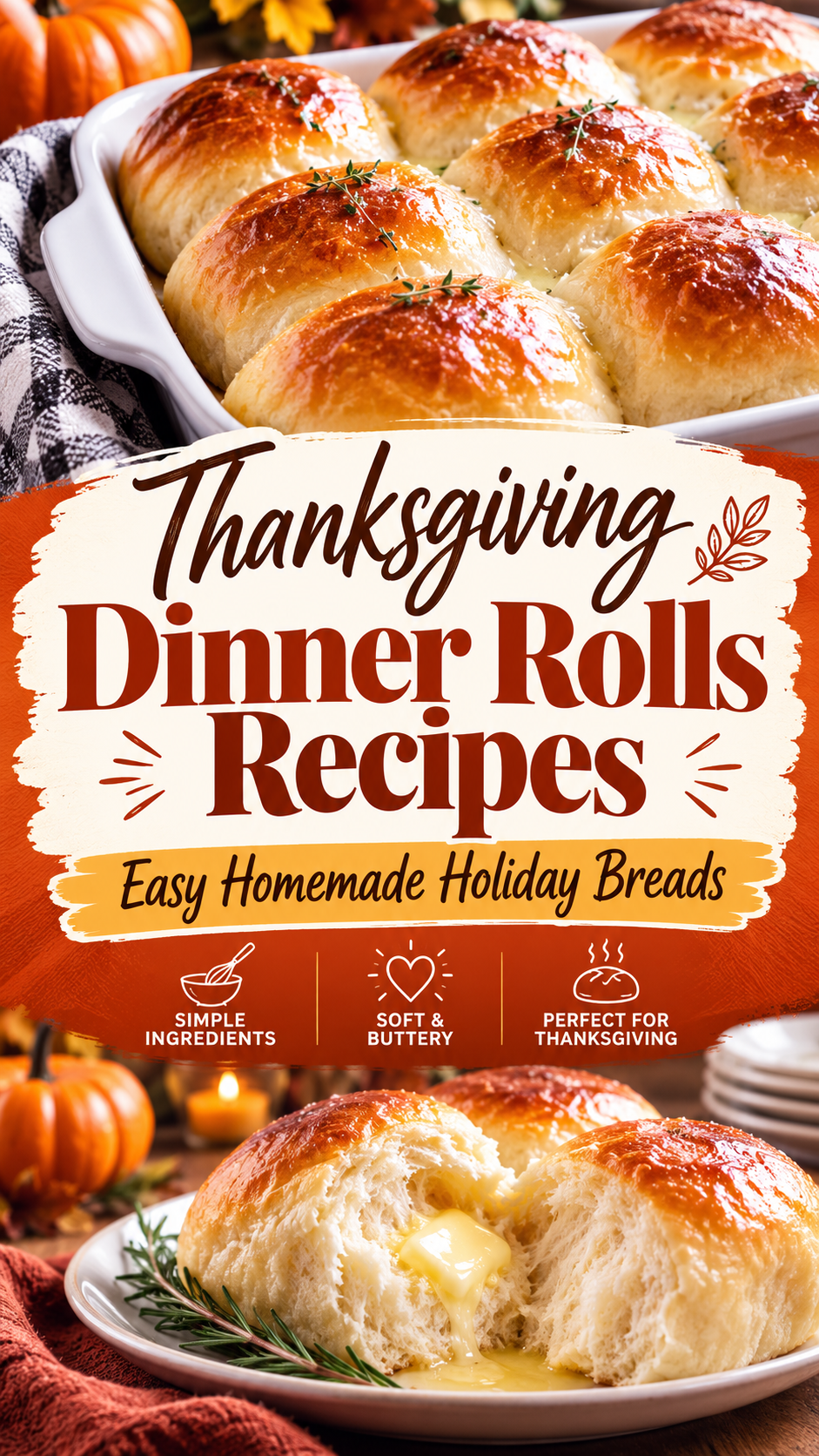
Thanksgiving rolls tend to disappear quietly.
Nobody talks about them as much as the turkey.
They don’t get their own gravy boat.
But put a basket of warm homemade rolls on the table and see how long they last.
Not very long.
Good Thanksgiving dinner rolls should be soft, buttery, easy to pull apart, and simple enough that bread-making does not become the most stressful part of the holiday.
For these Thanksgiving dinner roll recipes, we’re making classic buttery dinner rolls, honey whole wheat rolls, garlic herb rolls, soft potato rolls, and cheddar chive rolls.
Some are traditional.
Some have a little more flavor.
And all of them can be planned ahead so you’re not measuring flour while everyone else is waiting to eat.
What You’ll Need
Classic Buttery Dinner Rolls
- 3 1/2 to 4 cups all-purpose flour
- 2 1/4 teaspoons active dry yeast
- 1 cup whole milk
- 1/4 cup granulated sugar
- 5 tablespoons unsalted butter, divided
- 1 teaspoon salt
- 1 large egg
- 1 tablespoon melted butter, for brushing
Honey Whole Wheat Rolls
- 2 cups whole wheat flour
- 1 1/2 to 2 cups all-purpose flour
- 2 1/4 teaspoons active dry yeast
- 1 cup warm whole milk
- 1/4 cup honey
- 4 tablespoons unsalted butter, melted
- 1 large egg
- 1 teaspoon salt
- 1 tablespoon melted butter, for brushing
Garlic Herb Dinner Rolls
- 3 1/2 to 4 cups all-purpose flour
- 2 1/4 teaspoons active dry yeast
- 1 cup warm whole milk
- 2 tablespoons granulated sugar
- 4 tablespoons unsalted butter, melted
- 1 large egg
- 1 teaspoon salt
- 1 teaspoon garlic powder
- 1 teaspoon dried thyme
- 1 teaspoon dried rosemary
For the topping:
- 3 tablespoons unsalted butter, melted
- 2 cloves garlic, finely minced
- 1 tablespoon chopped fresh parsley
- Pinch of salt
Soft Potato Rolls
- 1 cup prepared plain mashed potatoes, cooled
- 3 1/2 to 4 cups all-purpose flour
- 2 1/4 teaspoons active dry yeast
- 3/4 cup warm whole milk
- 1/4 cup granulated sugar
- 4 tablespoons unsalted butter, melted
- 1 large egg
- 1 teaspoon salt
- 1 tablespoon melted butter, for brushing
Cheddar Chive Rolls
- 3 1/2 to 4 cups all-purpose flour
- 2 1/4 teaspoons active dry yeast
- 1 cup warm whole milk
- 2 tablespoons granulated sugar
- 4 tablespoons unsalted butter, melted
- 1 large egg
- 1 teaspoon salt
- 1 1/2 cups shredded sharp cheddar cheese
- 3 tablespoons chopped fresh chives
- 1 tablespoon melted butter, for brushing
Tools You’ll Need
- Large mixing bowls
- Medium mixing bowls
- Stand mixer with dough hook, optional
- Wooden spoon
- Rubber spatula
- Measuring cups and spoons
- Kitchen scale, optional
- Rolling surface or large cutting board
- Bench scraper
- 9×13-inch baking dishes
- Baking sheets
- Parchment paper
- Clean kitchen towel
- Pastry brush
- Instant-read thermometer, optional
- Wire cooling rack
1. Classic Buttery Dinner Rolls
If you only make one recipe from this collection, this is the safest place to start.
Soft.
Light.
Buttery.
And neutral enough to work with everything else on the Thanksgiving plate.
Warm the milk until it feels warm but not hot.
Around 105°F to 115°F works well for active dry yeast.
Pour it into a large bowl.
Add the sugar and yeast.
Let it sit for about 5 to 10 minutes, until foamy.
If nothing happens, the yeast may be old or the milk may have been too hot or too cold.
Better to discover that now than after an hour of staring at motionless dough.
Melt 4 tablespoons butter.
Let it cool slightly.
Add it to the yeast mixture along with the egg and salt.
Stir.
Add about 3 cups flour.
Mix until a rough dough forms.
Add the remaining flour gradually, only as needed.
The dough should be soft and slightly tacky.
Not dry.
Turn the dough onto a lightly floured surface.
Knead for about 7 to 9 minutes, until smooth and elastic.
If using a stand mixer, knead with the dough hook for about 5 to 7 minutes.
Place the dough in a lightly greased bowl.
Cover.
Let rise in a warm place for approximately 1 to 1 1/2 hours, or until roughly doubled.
Punch the dough down gently.
Divide into 15 equal pieces.
Shape each piece into a smooth ball.
Arrange in a greased 9×13-inch baking dish.
Cover.
Let rise again for about 30 to 45 minutes.
Preheat the oven to 375°F.
Bake for 18 to 22 minutes, until golden on top.
Brush immediately with melted butter.
Serve warm.
That’s the roll people tear open and drag through the last bit of gravy on the plate.
A respectable ending.
2. Honey Whole Wheat Rolls
Whole wheat rolls can become dense very quickly.
The solution is not using only whole wheat flour.
Mixing it with all-purpose flour gives you the nutty flavor without producing something that could double as a paperweight.
Combine the warm milk, honey, and yeast in a large bowl.
Let stand for 5 to 10 minutes.
Add melted butter, egg, and salt.
Stir.
Add the whole wheat flour.
Mix well.
Gradually add all-purpose flour until a soft dough forms.
Knead for about 8 minutes.
The dough should become smoother and more elastic.
Place in a greased bowl.
Cover.
Let rise for about 1 to 1 1/2 hours.
Divide into 15 pieces.
Shape into balls.
Arrange in a greased baking dish.
Cover and rise again for 30 to 45 minutes.
Bake at 375°F for 18 to 22 minutes.
Brush with melted butter.
These have just enough honey to soften the stronger whole wheat flavor.
They are not dessert rolls.
The pumpkin pie can keep that job.
Pro Tips for Better Homemade Dinner Rolls
Measure flour gradually. Adding too much flour is one of the fastest ways to make dry rolls.
Let the dough stay slightly tacky. Soft dough usually gives you softer bread.
Give yeast enough warmth, not heat. Very hot liquid can kill yeast.
Use rising time as a guide, not a rule. Dough rises faster in a warm kitchen and slower in a cool one.
Brush rolls with butter while they’re hot. It softens the crust and adds that holiday bakery smell people notice immediately.
3. Garlic Herb Dinner Rolls
These are the rolls to serve when your Thanksgiving menu leans savory.
Garlic and herbs make them especially good with turkey, gravy, stuffing, and roasted vegetables.
Combine warm milk, sugar, and yeast.
Let stand for 5 to 10 minutes.
Add melted butter, egg, salt, garlic powder, thyme, and rosemary.
Mix.
Add flour gradually until a soft dough forms.
Knead for 7 to 9 minutes.
Place the dough in a greased bowl.
Cover and rise until doubled, about 1 to 1 1/2 hours.
Divide into 15 pieces.
Shape into balls.
Arrange in a greased baking dish.
Cover and rise for another 30 to 45 minutes.
Bake at 375°F for 18 to 22 minutes.
Meanwhile, combine melted butter, minced garlic, parsley, and a pinch of salt.
Brush over the hot rolls as soon as they leave the oven.
The warm bread takes on the garlic butter beautifully.
A little warning.
If you put these on the table early, there is a good chance half of them will be gone before dinner starts.
4. Soft Potato Rolls
Mashed potatoes in bread might sound unnecessary.
It isn’t.
Potato helps bread stay soft and gives these rolls a tender texture that works very well for Thanksgiving.
It is also a useful way to use plain leftover mashed potatoes from holiday prep.
Use mashed potatoes without garlic, cheese, gravy, or anything else that would aggressively change the dough.
Combine warm milk, sugar, and yeast.
Let stand for 5 to 10 minutes.
Add mashed potatoes, melted butter, egg, and salt.
Mix until mostly smooth.
Add flour gradually.
The dough may feel slightly softer than standard dinner-roll dough.
That’s fine.
Knead for about 8 to 10 minutes.
Place in a greased bowl.
Cover and rise for about 1 to 1 1/2 hours.
Divide into 15 pieces.
Shape into smooth balls.
Arrange in a greased baking dish.
Cover and let rise for 30 to 45 minutes.
Bake at 375°F for 18 to 22 minutes.
Brush with melted butter.
These stay especially soft after cooling.
Which makes them a strong choice if you’re baking rolls earlier in the day.
Or if you’re already thinking about leftover turkey sandwiches.
No judgment.
That’s good planning.
5. Cheddar Chive Rolls
These are a little more substantial.
Cheddar adds savory flavor.
Chives keep things fresh.
And they work particularly well when your Thanksgiving menu is built around turkey and simple vegetable sides.
Combine warm milk, sugar, and yeast.
Let it stand for 5 to 10 minutes.
Add melted butter, egg, and salt.
Stir.
Add about 3 cups flour.
Mix.
Add the cheddar and chives.
Continue adding flour gradually until a soft dough forms.
Knead for about 7 to 9 minutes.
Some cheese may try to escape.
Put it back.
This is not complicated dough diplomacy.
Place the dough in a greased bowl.
Cover and rise for 1 to 1 1/2 hours.
Divide into 15 pieces.
Shape into balls.
Arrange in a baking dish.
Cover and let rise for another 30 to 45 minutes.
Preheat the oven to 375°F.
Bake for 18 to 22 minutes.
Brush with butter.
Let cool for a few minutes before serving.
The cheddar gives the rolls a slightly richer crumb without turning them into biscuits.
Which Thanksgiving Rolls Should You Make?
Think about what else is on the table.
| Roll | Flavor | Texture | Best With |
|---|---|---|---|
| Classic buttery | Mild, buttery | Soft and fluffy | Everything |
| Honey whole wheat | Slightly sweet, nutty | Soft, hearty | Turkey and vegetables |
| Garlic herb | Savory, herby | Soft | Gravy and stuffing |
| Potato | Mild, buttery | Extra tender | Make-ahead meals |
| Cheddar chive | Cheesy, savory | Soft, slightly rich | Turkey and ham |
For a traditional menu, make classic buttery rolls.
For a slightly heartier bread basket, go with whole wheat.
Garlic herb rolls are ideal when you want stronger savory flavor.
Potato rolls are excellent if softness is your priority.
And cheddar chive rolls work nicely when the table needs something a little different.
How to Know When Bread Dough Has Enough Flour
This is one of the most useful bread-making skills.
Recipe flour amounts are usually a range because flour behaves differently depending on humidity, brand, measuring technique, and even your kitchen.
The dough should feel:
- Soft
- Elastic
- Slightly tacky
- Easy to handle with lightly floured hands
It should not feel like wet batter.
It also should not become stiff.
If the dough sticks aggressively to everything, add flour a tablespoon or two at a time.
If you’re pouring flour into the bowl until the dough stops sticking completely, you’ve probably gone too far.
A small amount of tackiness is good.
Soft dough makes soft rolls.
How to Shape Smooth Dinner Rolls
After the first rise, divide the dough evenly.
A kitchen scale is helpful if you want rolls that bake at the same rate.
Take one piece of dough.
Pull the edges toward the bottom.
Pinch them together.
Place the dough seam-side down on the counter.
Cup your hand over it.
Roll gently in a circular motion until the top becomes smooth.
Arrange the rolls with a little space between them.
During the second rise, they’ll expand and begin touching.
That gives you the soft pull-apart sides people expect from dinner rolls.
If you want crust around every roll, space them farther apart on a baking sheet instead.
What If the Dough Isn’t Rising?
First, give it more time.
Bread dough does not own a watch.
A cool kitchen can turn a 60-minute rise into 90 minutes or longer.
If the kitchen is cold, place the covered bowl somewhere gently warm.
An oven that is turned off with the light on can work.
Do not put dough in a hot oven.
If there is still no activity after plenty of time, the yeast may have been inactive.
Possible causes include:
- Old yeast
- Liquid that was too hot
- A very cold environment
- Incorrect yeast quantity
If the yeast didn’t foam during the first mixing stage, starting again is usually easier than waiting several hours for dough that isn’t going anywhere.
Make-Ahead Thanksgiving Dinner Rolls
Bread can absolutely be made ahead.
You have a few options.
Option 1: Make the Dough the Day Before
Prepare the dough.
Let it complete the first rise.
Shape the rolls.
Arrange them in the baking dish.
Cover tightly.
Refrigerate overnight.
The next day, remove the rolls from the refrigerator.
Let them sit at room temperature until noticeably puffy, usually 45 to 90 minutes, depending on your kitchen.
Then bake.
This gives you freshly baked rolls without mixing dough on Thanksgiving morning.
Option 2: Bake Them One Day Ahead
Bake the rolls completely.
Cool them.
Store tightly covered at room temperature for one day.
Before serving, wrap loosely in foil.
Warm at 300°F for about 10 to 15 minutes.
Brush with a little melted butter after warming.
Option 3: Freeze Them
Bake and cool the rolls completely.
Freeze in an airtight freezer bag or container.
Thaw at room temperature.
Warm before serving.
This is an excellent option if Thanksgiving week is already packed.
A Simple Thanksgiving Roll Schedule
If you’re making fresh rolls for dinner around 5 p.m., you don’t need to begin at sunrise.
A rough schedule could look like this:
1:30 p.m. Make the dough.
2:00 p.m. Start the first rise.
3:15 p.m. Shape the rolls.
3:30 p.m. Begin second rise.
4:15 p.m. Preheat the oven.
4:30 p.m. Bake.
4:50 p.m. Brush with butter.
5:00 p.m. Eat.
Actual rising times vary.
The dough gets the final vote.
If your oven is busy with casseroles, use the overnight method instead.
Thanksgiving already has enough scheduling negotiations.
How Many Dinner Rolls Do You Need?
For a large holiday meal, plan about 1 to 2 rolls per person.
For 8 people:
- 12 to 16 rolls is usually comfortable.
For 12 people:
- 18 to 24 rolls gives you plenty.
For 20 people:
- 30 to 36 rolls works well.
Why more than one each?
Because the first roll gets eaten with dinner.
The second gets used for gravy.
And there is always one person quietly preparing a turkey sandwich before dessert.
Can You Use Instant Yeast?
Yes.
Instant yeast can usually be mixed directly into the flour instead of being dissolved first.
You can use approximately the same amount.
The dough may rise a little faster, so watch the dough rather than relying strictly on the clock.
If you’re nervous about yeast, active dry yeast is useful because the foaming step lets you confirm that it is alive before committing the rest of your ingredients.
Either works.
Substitutions and Variations
Whole milk: Use 2% milk if needed.
Butter: A suitable dairy-free butter can work, though flavor and texture may vary.
All-purpose flour: Bread flour can make slightly chewier rolls.
Honey: Maple syrup can replace honey in the whole wheat rolls.
Whole wheat flour: Use white whole wheat flour for a milder flavor.
Cheddar: Try Gruyère, Monterey Jack, or Parmesan.
Chives: Green onions can work.
Fresh herbs: Use smaller amounts of dried herbs.
Mashed potatoes: Plain instant mashed potatoes prepared according to package directions can work in a pinch, but avoid heavily seasoned varieties.
For egg-free rolls, use a tested egg-free bread formula rather than simply removing the egg from these recipes, since egg contributes structure and richness.
How to Keep Dinner Rolls Soft
The biggest enemies are too much flour and too much baking.
Keep the dough soft.
Bake only until golden and cooked through.
Brush the rolls with butter after baking.
Then cover them loosely with a clean kitchen towel as they cool slightly.
If storing overnight, keep them in an airtight container once completely cool.
For reheating, wrap the rolls in foil.
Dry oven heat will make uncovered rolls progressively harder.
Nobody wants a Thanksgiving roll capable of injuring the gravy boat.
How to Tell When Rolls Are Done
Golden tops are the first clue.
The bottoms should also have some color.
If you use an instant-read thermometer, enriched dinner rolls are generally done when the center is around 190°F.
They should sound slightly hollow when tapped.
Don’t bake them until they’re dark brown unless that’s the style you want.
Dinner rolls continue firming as they cool.
Pull them once they’re properly baked and golden.
What to Serve With Thanksgiving Dinner Rolls
The shorter question would be what not to serve with them.
Dinner rolls are excellent with:
- Roast turkey
- Turkey breast
- Gravy
- Stuffing
- Mashed potatoes
- Green beans
- Cranberry sauce
- Sweet potato casserole
- Mac and cheese
- Corn casserole
- Roasted vegetables
They are also useful for catching sauces that have escaped everything else on the plate.
And after dinner, leftover rolls make excellent mini sandwiches with turkey and cranberry sauce.
That is probably reason enough to make extra.
Flavored Butter Ideas for the Table
Regular butter is perfectly fine.
But flavored butter is easy to prepare ahead and can make the bread basket feel a little more special.
Honey Butter
Mix:
- 1/2 cup softened butter
- 2 tablespoons honey
- Pinch of salt
Herb Butter
Mix:
- 1/2 cup softened butter
- 1 tablespoon chopped parsley
- 1 teaspoon thyme
- 1/2 teaspoon rosemary
- Pinch of salt
Maple Cinnamon Butter
Mix:
- 1/2 cup softened butter
- 2 tablespoons maple syrup
- 1/4 teaspoon cinnamon
- Pinch of salt
Garlic Butter
Mix:
- 1/2 cup softened butter
- 1 small garlic clove, finely grated
- 1 tablespoon parsley
- Pinch of salt
Keep flavored butter refrigerated until needed.
Allow it to soften slightly before serving.
Leftovers and Storage
Let the rolls cool completely before storing.
Keep them in an airtight container at room temperature for about 2 days.
For longer storage, refrigerate or freeze them.
Refrigeration can make bread feel firmer, so warm chilled rolls before serving.
To reheat:
Wrap the rolls loosely in foil.
Warm at 300°F for about 10 to 15 minutes.
Brush with butter after heating if desired.
To freeze:
Place cooled rolls in a freezer-safe bag.
Remove as much air as practical.
Freeze.
Thaw at room temperature before reheating.
Leftover rolls can become:
- Turkey sliders
- Breakfast sandwiches
- Mini grilled cheese
- Bread pudding
- Croutons
- Stuffing
- Garlic bread
Day-old rolls becoming stuffing feels especially appropriate after Thanksgiving.
They’ve simply moved into another department.
Frequently Asked Questions
Can Thanksgiving dinner rolls be made the day before?
Yes. You can refrigerate shaped dough overnight or bake the rolls completely one day ahead and reheat them before serving.
How do I keep homemade rolls soft?
Avoid adding too much flour, don’t overbake them, brush with butter, and store them tightly covered once cool.
Why are my dinner rolls dense?
Common causes include too much flour, insufficient kneading, inactive yeast, or not allowing enough rising time.
Can I use instant yeast instead of active dry yeast?
Yes. Use a similar amount and mix it directly with the dry ingredients. Watch the dough because it may rise faster.
How many rolls should I make per person for Thanksgiving?
Plan roughly 1 to 2 rolls per person.
Can I freeze homemade dinner rolls?
Yes. Bake and cool them first, then freeze in an airtight container or freezer bag.
What temperature should I bake dinner rolls at?
These recipes bake at 375°F.
Can I make the dough without a stand mixer?
Absolutely. Mix with a wooden spoon and knead by hand.
Why didn’t my yeast foam?
The yeast may be old, or the liquid temperature may have been too hot or too cold.
What are the best rolls for leftover turkey sandwiches?
Classic buttery rolls and potato rolls are especially good because they’re soft and fairly neutral in flavor.
Wrapping Up
Homemade Thanksgiving dinner rolls don’t need to become an all-day bread project.
Make classic buttery rolls when you want the traditional soft basket of bread.
Choose honey whole wheat rolls for something a little heartier.
Go with garlic herb rolls when you’re planning to use every last drop of gravy.
Bake potato rolls if extra-soft texture matters most.
Or add cheddar and chives when you want the rolls to bring a little more flavor of their own.
Better yet, shape them the night before.
Let the refrigerator handle the waiting.
Then bake them while the turkey rests or the casseroles finish.
Warm rolls arrive at the table.
Butter appears.
And approximately three minutes later, someone asks if there are any more.
Make extra.