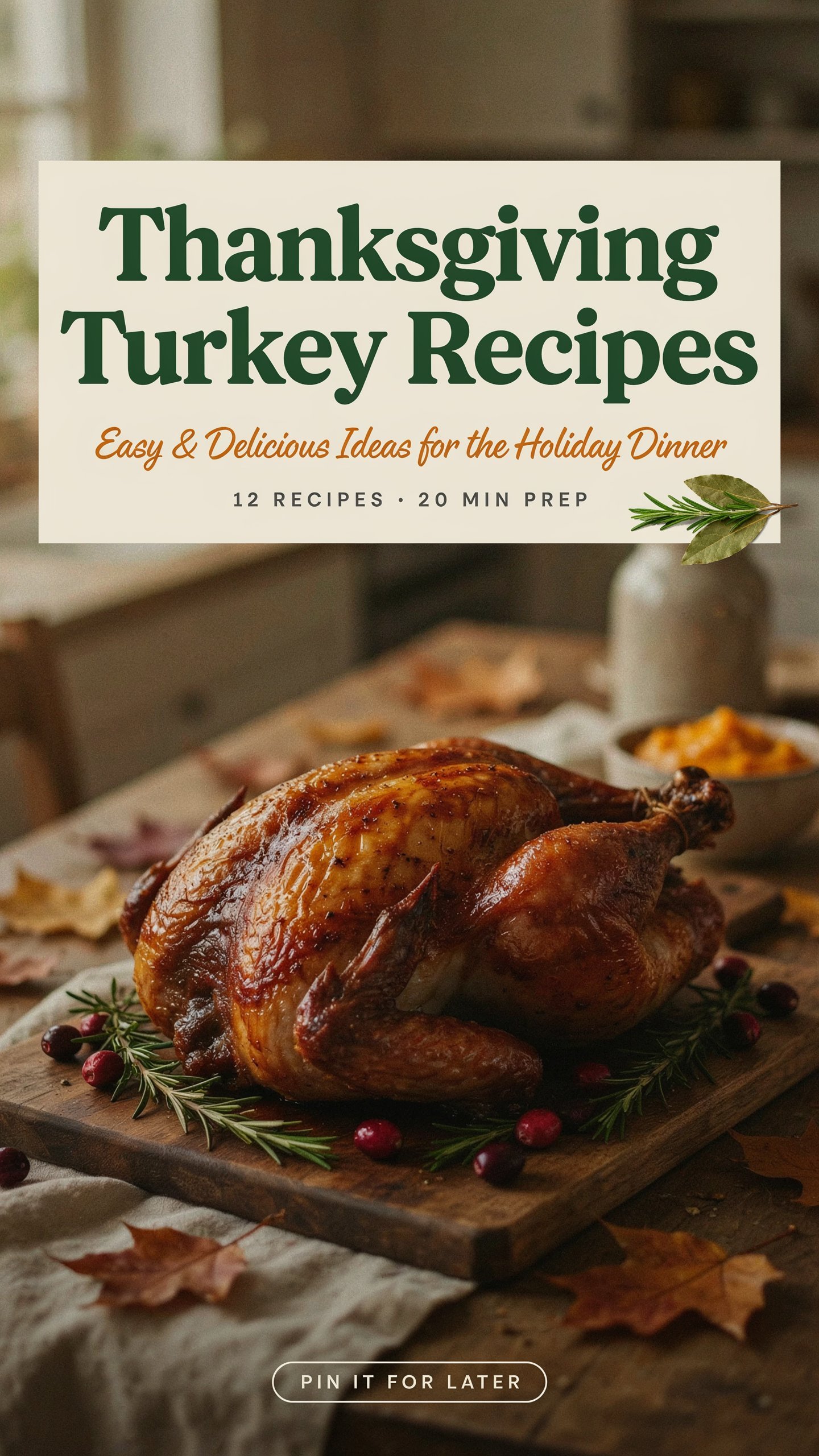
The turkey has a slightly unfair Thanksgiving job.
It has to feed nearly everyone, look impressive when it reaches the table, stay juicy, develop golden skin, and somehow finish cooking at roughly the same time as everything else.
No pressure.
The good news is that Thanksgiving turkey doesn’t have to mean one enormous bird cooked exactly one way.
Depending on your guest list and kitchen setup, a whole roasted turkey might make sense. For a smaller gathering, turkey breast can be much easier. If crispy skin matters most, a spatchcocked turkey is hard to beat. And if you want a little more flavor, herb butter or maple garlic glaze can completely change the final result.
These five Thanksgiving turkey recipes cover all of those situations: classic herb butter roast turkey, garlic rosemary turkey breast, maple glazed turkey, spatchcocked Thanksgiving turkey, and slow cooker turkey breast.
Choose the one that makes Thanksgiving easier for your table.
What You’ll Need
Classic Herb Butter Roast Turkey
- 1 whole turkey, 12 to 14 pounds, completely thawed
- 8 tablespoons unsalted butter, softened
- 4 cloves garlic, minced
- 1 tablespoon chopped fresh sage
- 1 tablespoon chopped fresh rosemary
- 1 tablespoon fresh thyme leaves
- 2 teaspoons kosher salt
- 1 teaspoon black pepper
- 1 lemon, halved
- 1 large yellow onion, quartered
- 4 fresh thyme sprigs
- 3 fresh rosemary sprigs
- 2 cups chicken or turkey broth
Garlic Rosemary Turkey Breast
- 1 bone-in turkey breast, 5 to 7 pounds
- 5 tablespoons unsalted butter, softened
- 4 cloves garlic, minced
- 1 tablespoon finely chopped fresh rosemary
- 2 teaspoons fresh thyme leaves
- 1 teaspoon chopped fresh sage
- 1 1/2 teaspoons kosher salt
- 1/2 teaspoon black pepper
- 1 tablespoon olive oil
- 1 large yellow onion, sliced
- 1 cup chicken or turkey broth
- 1 lemon, halved
Maple Garlic Glazed Turkey
- 1 whole turkey, 10 to 12 pounds, completely thawed
- 6 tablespoons unsalted butter, softened
- 4 cloves garlic, minced
- 2 teaspoons kosher salt
- 1 teaspoon black pepper
- 1 teaspoon dried thyme
- 1 teaspoon dried sage
- 1 large yellow onion, quartered
- 1 orange, quartered
- 2 cups chicken or turkey broth
For the maple glaze:
- 1/2 cup pure maple syrup
- 3 tablespoons unsalted butter
- 2 tablespoons Dijon mustard
- 1 tablespoon apple cider vinegar
- 1 teaspoon fresh thyme leaves
Herb Butter Spatchcocked Turkey
- 1 whole turkey, 10 to 12 pounds, completely thawed
- 6 tablespoons unsalted butter, softened
- 3 tablespoons olive oil
- 5 cloves garlic, minced
- 1 tablespoon chopped fresh rosemary
- 1 tablespoon fresh thyme leaves
- 1 tablespoon chopped fresh sage
- 2 teaspoons kosher salt
- 1 teaspoon black pepper
- 2 large yellow onions, thickly sliced
- 3 carrots, roughly chopped
- 3 celery stalks, roughly chopped
- 1 cup chicken or turkey broth
Slow Cooker Herb Turkey Breast
- 1 boneless turkey breast, 3 to 4 pounds, completely thawed
- 3 tablespoons unsalted butter, softened
- 3 cloves garlic, minced
- 1 teaspoon dried thyme
- 1 teaspoon dried rosemary
- 1/2 teaspoon dried sage
- 1 teaspoon kosher salt
- 1/2 teaspoon black pepper
- 1 teaspoon smoked paprika
- 1 large yellow onion, thickly sliced
- 2 celery stalks, chopped
- 1/2 cup chicken or turkey broth
- 2 tablespoons chopped fresh parsley
Tools You’ll Need
Turkey is easier when the equipment is ready before raw poultry is on your hands.
- Large roasting pan
- Roasting rack
- Rimmed baking sheet
- Oven-safe wire rack
- 6-quart slow cooker
- Large cutting board
- Chef’s knife
- Poultry shears
- Small mixing bowls
- Pastry brush
- Kitchen twine
- Aluminum foil
- Measuring cups and spoons
- Instant-read meat thermometer
- Carving knife
- Tongs
- Large serving platter
- Ladle
- Fat separator, optional
1. Classic Herb Butter Roast Turkey
If your Thanksgiving mental picture includes a whole golden turkey arriving at the table, start here.
This version stays traditional.
Butter.
Garlic.
Sage.
Rosemary.
Thyme.
And enough pan drippings to give tomorrow’s gravy something useful to work with.
Prepare the Turkey
Make sure the turkey is completely thawed.
Remove the neck and giblets from the cavities.
Pat the turkey thoroughly dry with paper towels.
Do not rinse raw turkey. Washing poultry can splash bacteria around the sink and nearby surfaces.
Preheat the oven to 325°F.
Combine the softened butter, garlic, sage, rosemary, thyme, salt, and black pepper.
Carefully loosen the skin over the breast with your fingers.
Spread some herb butter underneath the skin.
Rub the remaining butter over the outside of the turkey.
Place the lemon, onion, thyme sprigs, and rosemary inside the cavity without packing it tightly.
Tuck the wing tips underneath the bird.
Tie the legs loosely with kitchen twine if desired.
Place the turkey breast-side up on a rack inside the roasting pan.
Pour the broth into the bottom of the pan.
Roast the Turkey
Roast at 325°F.
A 12 to 14-pound unstuffed turkey will often need roughly 3 to 3 3/4 hours, but time is only a guide.
Temperature decides when your turkey is done.
Start checking before the estimated finish time.
The turkey is safely cooked when the thickest parts of the breast and the innermost thigh and wing reach at least 165°F, taking care not to touch bone with the thermometer.
If the skin browns too quickly, loosely cover the top with foil.
Once cooked, remove the turkey from the oven.
Let it rest for at least 20 minutes before carving.
A larger bird can comfortably rest a little longer.
Do not immediately attack it with the carving knife.
You’ve spent hours getting those juices into the turkey.
Give them a chance to stay there.
2. Garlic Rosemary Turkey Breast
Not every Thanksgiving needs a 14-pound turkey.
If you’re feeding a smaller group, turkey breast can be much less stressful.
You get the familiar roast turkey flavor without giving an enormous bird temporary ownership of the oven.
Preheat the oven to 350°F.
Pat the turkey breast dry.
Combine butter, garlic, rosemary, thyme, sage, salt, and black pepper.
Rub some of the herb butter underneath the skin.
Spread the rest over the outside.
Rub lightly with olive oil.
Arrange the sliced onion in the bottom of a roasting pan.
Set the turkey breast on top.
Add the broth and lemon halves to the pan.
Roast until the thickest part of the breast reaches 165°F.
A 5 to 7-pound bone-in breast commonly takes around 1 1/2 to 2 1/2 hours, depending on its shape and your oven.
Start checking early.
If the skin needs more color near the end, increase the oven temperature briefly or use the broiler carefully.
Stay nearby.
The distance between beautifully browned turkey skin and explaining the smoke alarm to your guests can be surprisingly short.
Rest for about 15 to 20 minutes before slicing.
Spoon some of the pan juices over the carved meat before serving.
Pro Tips for Better Thanksgiving Turkey
Thaw early. A whole frozen turkey can take several days to thaw safely in the refrigerator. Allow roughly 24 hours for every 4 to 5 pounds.
Pat the skin dry. Surface moisture makes browning more difficult.
Use a thermometer, not the clock alone. Turkey size, shape, oven accuracy, and starting temperature all affect cooking time.
Let the turkey rest. Cutting immediately encourages juices to run onto the board instead of staying in the meat.
Don’t stuff the cavity tightly. Cooking stuffing separately is easier to control and helps the turkey cook more predictably.
3. Maple Garlic Glazed Turkey
Maple syrup can be excellent on turkey.
The trick is not turning the entire bird into breakfast.
Dijon mustard, garlic, vinegar, thyme, and plenty of savory seasoning keep this glaze balanced.
Preheat the oven to 325°F.
Pat the thawed turkey dry.
Mix the softened butter with garlic, salt, black pepper, thyme, and sage.
Rub the mixture underneath and over the skin.
Put the onion and orange quarters loosely inside the cavity.
Place the turkey on a roasting rack.
Pour broth into the roasting pan.
Roast normally for the first portion of cooking.
Meanwhile, prepare the glaze.
Combine maple syrup, butter, Dijon mustard, apple cider vinegar, and thyme in a small saucepan.
Heat gently until the butter melts.
Whisk until smooth.
During roughly the final 45 minutes of roasting, begin brushing the turkey lightly with glaze.
Repeat once or twice.
Don’t start glazing too early.
Maple syrup contains sugar, and sugar is much more enthusiastic about burning than turkey is about cooking.
Continue roasting until the turkey reaches 165°F in the required areas.
Rest for at least 20 minutes.
The result is still unmistakably roast turkey, just with a slightly sweet, glossy outer layer.
This works especially well if your Thanksgiving menu leans savory.
4. Herb Butter Spatchcocked Turkey
This turkey will not give you the classic tall whole-bird presentation.
What it gives you instead is faster cooking, lots of exposed skin, and more even roasting.
That is a pretty good trade.
Spatchcocking simply means removing the backbone and flattening the bird.
If cutting through a turkey backbone doesn’t sound like your preferred Thanksgiving morning activity, ask your butcher to do it when you buy the bird.
A sensible delegation.
Prepare the Turkey
Place the turkey breast-side down on a large cutting board.
Using sturdy poultry shears, cut along both sides of the backbone and remove it.
Turn the turkey breast-side up.
Press firmly on the center of the breast until the bird flattens.
Pat completely dry.
Preheat the oven to 425°F.
Combine butter, olive oil, garlic, rosemary, thyme, sage, salt, and black pepper.
Rub the mixture all over the turkey, including underneath the skin where possible.
Arrange onions, carrots, and celery across a rimmed baking sheet or roasting pan.
Set an oven-safe wire rack over the vegetables if you have one.
Place the flattened turkey on top, breast-side up.
Pour the broth into the pan beneath the rack.
Roast
Roast at 425°F.
A 10 to 12-pound spatchcocked turkey may cook in roughly 70 to 100 minutes, though actual time varies.
Begin checking the temperature early.
Cook until the thickest parts of the breast and the innermost thigh and wing reach at least 165°F.
If one area finishes earlier, loosely cover it with foil while the rest continues cooking.
Rest for at least 20 minutes before carving.
This method also creates plenty of browned bits and drippings underneath the turkey.
Do not throw those away.
Gravy would like a word.
5. Slow Cooker Herb Turkey Breast
There are days when the oven simply has too many responsibilities.
Thanksgiving is one of them.
A slow cooker turkey breast frees the oven for stuffing, casseroles, rolls, and whatever else is waiting impatiently for rack space.
Place the sliced onion and celery in the bottom of a 6-quart slow cooker.
Pour in the broth.
Combine butter, garlic, thyme, rosemary, sage, salt, black pepper, and smoked paprika.
Pat the turkey breast dry.
Rub the seasoned butter all over it.
Place the turkey on top of the vegetables.
Cover.
Cook on LOW for approximately 5 to 7 hours, depending on the size and shape of the turkey breast and your slow cooker.
Begin checking before the end of the estimated cooking window.
The turkey is done when the thickest part reaches 165°F.
Transfer it carefully to a baking sheet.
If you want a browned exterior, place it under the broiler for a few minutes.
Watch constantly.
Rest for about 15 minutes.
Finish with fresh parsley before slicing.
Use LOW or HIGH to cook raw turkey.
The WARM setting is for holding food that has already been safely cooked, not for cooking raw poultry.
Which Thanksgiving Turkey Should You Make?
Think about guest count and oven space before choosing.
| Turkey | Difficulty | Cooking Style | Best For |
|---|---|---|---|
| Classic herb butter | Moderate | Oven roasted | Traditional dinner |
| Garlic rosemary breast | Easy | Oven roasted | Smaller gathering |
| Maple glazed | Moderate | Oven roasted | Sweet-savory menu |
| Spatchcocked | Moderate | High-heat roast | Faster cooking |
| Slow cooker breast | Easy | Slow cooker | Saving oven space |
For a traditional centerpiece, go with the whole herb butter turkey.
For four to six people, a turkey breast may make far more sense.
For faster roasting and lots of crispy skin, spatchcock the bird.
And if every oven rack is already spoken for, use the slow cooker.
How Much Turkey Do You Need?
A useful rule for a whole bone-in turkey is approximately 1 to 1 1/2 pounds per person.
That accounts for bones and gives you some room for leftovers.
For 8 people, a turkey around 10 to 12 pounds can work well.
For 10 people, look around 12 to 15 pounds.
For 12 people, approximately 14 to 18 pounds gives you more room.
Guest appetite and desired leftovers matter.
If Thanksgiving sandwiches are part of the plan, buy accordingly.
For a boneless turkey breast, you’ll need considerably less weight per person because you’re not paying for a large skeleton at the grocery store.
The Turkey Thawing Schedule Matters
This is one Thanksgiving job you cannot fix with an extra 20 minutes.
Frozen whole turkeys take time.
For refrigerator thawing, allow roughly 24 hours for every 4 to 5 pounds of turkey.
That means a 12-pound bird needs roughly 3 days.
A larger turkey may need 4 or 5.
Keep it refrigerated at 40°F or below while thawing.
Place the wrapped turkey on a tray or pan to catch any leaking liquid.
Need to Thaw It Faster?
A turkey can be thawed using the cold-water method while kept in leak-proof packaging.
Submerge it in cold water and change the water every 30 minutes.
Allow approximately 30 minutes per pound.
A turkey thawed using the cold-water method should be cooked immediately.
Do not thaw turkey on the kitchen counter.
The center may still be frozen while the outside spends too long at unsafe temperatures.
Should You Brine Your Thanksgiving Turkey?
You can.
You don’t have to.
Brining can add seasoning and help with moisture retention, but check the turkey packaging first.
Some birds are already injected, enhanced, koshered, or otherwise salted.
Brining one of those again can give you an unpleasantly salty turkey.
For an untreated turkey, you can use a wet or dry brine.
Dry brining is especially convenient because it doesn’t require finding refrigerator space for a giant container of liquid.
Season the turkey with salt and refrigerate it uncovered according to your chosen dry-brine recipe.
The uncovered refrigerator time can also help dry the skin.
Drier skin means better browning.
Getting Golden, Crispy Turkey Skin
Turkey skin needs a little cooperation.
First, dry the turkey thoroughly.
Then use butter, oil, or a combination of both.
Don’t repeatedly open the oven unless necessary.
Every inspection releases heat.
If the skin is still pale toward the end but the turkey needs more cooking, you can increase the oven temperature slightly.
If the opposite happens and the skin gets dark too quickly, loosely tent the browned areas with foil.
Don’t cover the entire turkey tightly for the whole roasting process.
Trapped steam works against crisp skin.
Don’t Trust the Pop-Up Timer Alone
If your turkey comes with a pop-up timer, treat it as an extra signal.
Not your only signal.
Use an instant-read thermometer.
Check the thickest part of the breast.
Check the innermost thigh.
Check the innermost wing.
Avoid touching bone with the thermometer probe.
All should reach at least 165°F for food safety.
A reliable thermometer is one of the most useful Thanksgiving tools you can own.
It costs considerably less than the turkey.
And it gets invited back every year.
Make-Ahead Thanksgiving Turkey Plan
You cannot roast the whole turkey three days early and expect peak Thanksgiving results.
But plenty of preparation can happen ahead.
Three to Five Days Before
Move a frozen turkey into the refrigerator according to its size.
Make sure it has enough time to thaw completely.
Two Days Before
You can:
- Chop herbs
- Prepare compound herb butter
- Check your roasting pan
- Find the thermometer
- Prepare broth or stock
- Chop vegetables for the roasting pan
This is also a good time to dry-brine if you’re using that method.
One Day Before
Make sure the turkey is fully thawed.
Prepare any glaze.
Organize your carving tools.
Prepare serving platters.
If your recipe and turkey allow it, season the bird ahead and refrigerate safely.
Thanksgiving Day
Take the turkey from the refrigerator while you prepare the remaining ingredients, but don’t leave raw poultry sitting at room temperature for extended periods.
Roast according to your chosen method.
Check the temperature early.
Rest the turkey.
Use that resting period to finish gravy and reheat sides.
Then carve.
How to Carve a Turkey Without Creating a Disaster
You do not need to carve the turkey dramatically at the dining table.
The kitchen is easier.
After the turkey rests, transfer it to a stable cutting board.
Remove the legs first.
Separate the drumsticks from the thighs.
Remove the breast meat from each side of the breastbone.
Then slice the breast meat across the grain.
Remove the wings.
Arrange everything on a warm serving platter.
Spoon a little warm broth or pan juice over the meat if desired.
Garnish with fresh herbs.
Now bring the platter to the table.
You still get the impressive turkey moment.
You simply skipped the part where everyone watches you search for the hip joint.
Easy Flavor Variations
Once you understand the basic roasting method, turkey seasoning is easy to change.
Lemon Herb
Use:
- Lemon zest
- Garlic
- Thyme
- Rosemary
- Parsley
Garlic Sage
Use:
- Plenty of garlic
- Fresh sage
- Butter
- Black pepper
Orange Rosemary
Use:
- Orange zest
- Rosemary
- Thyme
- Garlic
Smoky Herb
Use:
- Smoked paprika
- Garlic
- Thyme
- Black pepper
Maple Dijon
Use:
- Maple syrup
- Dijon mustard
- Apple cider vinegar
- Thyme
Keep the flavors relatively simple.
The turkey has to work with gravy, stuffing, cranberry sauce, potatoes, vegetables, and everything else on the plate.
This is not the moment for seventeen competing spices.
What to Serve With Thanksgiving Turkey
The turkey may be the centerpiece, but the surrounding dishes make the meal.
Serve it with:
- Mashed potatoes
- Turkey gravy
- Stuffing
- Cranberry sauce
- Sweet potato casserole
- Green bean casserole
- Roasted Brussels sprouts
- Glazed carrots
- Thanksgiving salad
- Dinner rolls
- Mac and cheese
- Corn casserole
If your turkey has a sweet maple glaze, balance it with savory vegetables and stuffing.
For classic herb turkey, nearly every traditional Thanksgiving side works.
For garlic rosemary turkey breast, creamy mashed potatoes and cranberry sauce make an especially easy combination.
What to Do With Turkey Drippings
Do not automatically discard what’s left in the roasting pan.
Those drippings can become some of the most flavorful gravy on the table.
Pour them carefully into a fat separator or heatproof measuring container.
Let the fat separate.
Use some of the fat to make a roux with flour.
Then use the flavorful juices along with broth to build the gravy.
Taste before adding salt.
The drippings may already contain plenty from the seasoned turkey.
If you’re not making gravy immediately, refrigerate the drippings promptly.
Leftovers and Storage
Turkey leftovers are one of Thanksgiving’s better features.
Do not leave cooked turkey at room temperature for longer than 2 hours, or 1 hour when temperatures are above 90°F.
Remove the remaining meat from the carcass.
Transfer it to shallow airtight containers.
Refrigerate for 3 to 4 days.
Reheat leftovers to 165°F.
For longer storage, freeze cooked turkey in freezer-safe containers.
Adding a little broth before freezing can help keep sliced meat from drying out.
Leftover turkey can become:
- Turkey sandwiches
- Turkey soup
- Turkey pot pie
- Turkey tacos
- Turkey casserole
- Turkey salad
- Turkey quesadillas
- Turkey and cranberry sliders
This is why I don’t worry too much about having a little extra.
The leftovers already have plans.
Frequently Asked Questions
What is the easiest turkey to make for Thanksgiving?
A turkey breast is generally easier to handle than a whole turkey. A slow cooker turkey breast can also free valuable oven space.
How long does a Thanksgiving turkey take to cook?
It depends on weight, preparation method, oven temperature, and whether the bird is whole or spatchcocked. Use cooking times only as estimates and verify doneness with a food thermometer.
What temperature should turkey reach?
The thickest part of the breast and the innermost thigh and wing should reach at least 165°F.
Should I rinse turkey before cooking?
No. Rinsing raw poultry can spread bacteria through splashing. Pat the turkey dry instead.
How long should turkey rest before carving?
Give a whole turkey at least about 20 minutes. A turkey breast can generally rest for around 15 to 20 minutes.
How much turkey should I buy per person?
For a whole bone-in turkey, around 1 to 1 1/2 pounds per person is a useful starting point.
Can I cook turkey the day before Thanksgiving?
You can cook turkey ahead, but freshly roasted turkey usually has better skin and texture. Much of the seasoning, chopping, and other preparation can be done beforehand instead.
Can I cook a frozen turkey without thawing it?
Cooking from frozen requires a different method and significantly more time. For these recipes, thaw the turkey completely before beginning.
Why is my turkey breast dry?
Overcooking is one of the most common causes. Use a thermometer and begin checking before the estimated cooking time ends.
What can I use instead of a whole turkey?
Turkey breast is the simplest alternative and works especially well for smaller Thanksgiving gatherings.
Wrapping Up
A good Thanksgiving turkey doesn’t need a complicated secret.
It needs enough time to thaw.
Plenty of seasoning.
A reliable thermometer.
And someone willing to take it out of the oven when it’s actually done instead of giving it another 30 minutes “just to be safe.”
Make the classic herb butter turkey when you want the traditional centerpiece.
Choose garlic rosemary turkey breast for a smaller dinner.
Use maple glaze when you want a subtle sweet-savory finish.
Try the spatchcocked turkey for faster roasting and plenty of crisp skin.
Or move the turkey breast into the slow cooker when the oven is already booked solid.
Then let it rest, carve it in the kitchen, save those drippings for gravy, and bring the platter to the table.
The turkey has done enough work by then.
So have you.