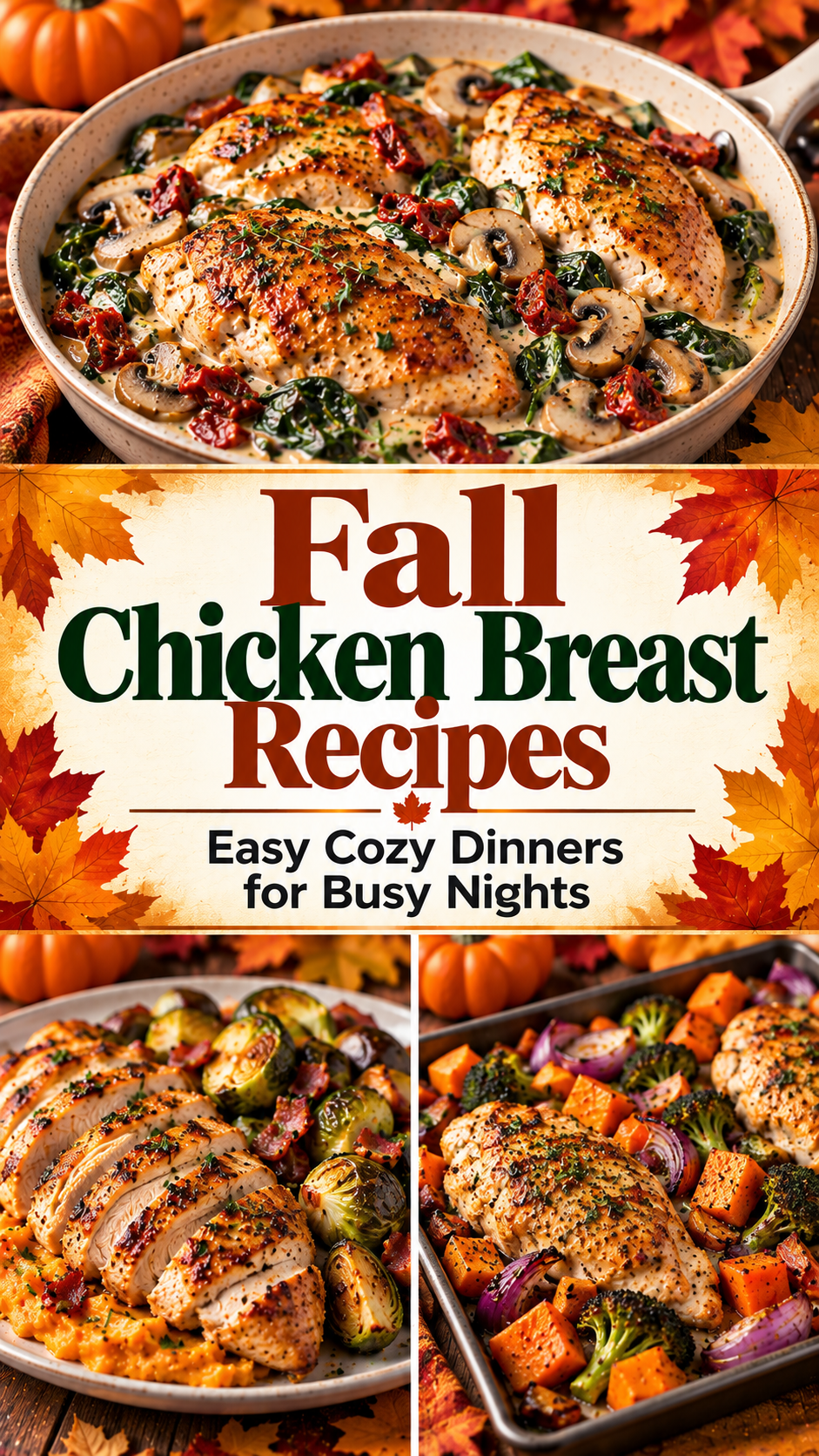
Chicken breast is probably already somewhere in your weekly dinner rotation.
The problem isn’t finding chicken breast.
It’s finding another way to cook it that doesn’t taste like the same Tuesday-night chicken you’ve made seventeen times before.
Fall makes that considerably easier.
Suddenly there are apples, mushrooms, sweet potatoes, butternut squash, sage, rosemary, maple, Dijon, cider, and creamy sauces to work with. A package of chicken breasts can become something completely different depending on which autumn ingredient you pair with it.
So for this collection, forget plain baked chicken.
We’re making the kind of dinners that feel cozy enough for a chilly evening but practical enough for a busy weeknight.
Monday: Apple Cider Dijon Chicken
This is the recipe to make when you want something that tastes distinctly autumnal without committing your entire evening to dinner.
For 4 servings:
- 4 boneless, skinless chicken breasts
- 1 tablespoon olive oil
- 1 tablespoon butter
- 1 crisp apple, sliced
- 1 small shallot, sliced
- 3/4 cup apple cider
- 1/2 cup chicken broth
- 1 tablespoon Dijon mustard
- 1 teaspoon fresh thyme
- Salt and black pepper
If your chicken breasts are extremely thick, pound them gently to a more even thickness.
Season both sides with salt and pepper.
Heat olive oil in a large skillet over medium-high heat.
Add the chicken and cook until nicely browned on both sides. Transfer it temporarily to a plate.
It doesn’t need to be completely cooked yet.
Add butter to the same skillet.
Cook the apple slices until lightly golden, then remove them so they don’t become too soft.
Add the shallot.
Once softened, pour in the cider and broth.
Scrape the browned bits from the bottom of the skillet.
Those browned bits are doing important work.
Whisk in Dijon and thyme.
Return the chicken to the skillet and simmer gently until it reaches 165°F internally.
Add the apples back for the final couple of minutes.
Spoon plenty of sauce over the chicken.
Mashed potatoes are the obvious side here.
I see no reason to resist the obvious.
Tuesday: Creamy Garlic Mushroom Chicken
Tuesday requires something comforting.
Preferably something that can be eaten with crusty bread.
You’ll need:
- 4 chicken breasts
- 12 ounces cremini mushrooms
- 2 tablespoons olive oil
- 2 tablespoons butter
- 3 garlic cloves, minced
- 1 teaspoon fresh thyme
- 3/4 cup chicken broth
- 1/2 cup heavy cream
- 1/3 cup grated Parmesan
- Salt and black pepper
Season the chicken.
Heat olive oil in a large skillet and brown the chicken on both sides.
Transfer it to a plate.
Add butter and sliced mushrooms.
Let the mushrooms actually brown before stirring them constantly.
If your skillet is small, cook them in two batches.
Crowded mushrooms release water and steam each other.
Once they’re nicely browned, add garlic and thyme.
Pour in the broth and let it simmer for a few minutes.
Reduce the heat and stir in the cream and Parmesan.
Return the chicken to the skillet.
Cook gently until the chicken reaches 165°F and the sauce has thickened.
Taste before adding additional salt because the Parmesan and broth may already provide plenty.
Serve with mashed potatoes, pasta, rice, or bread.
Broccoli or green beans are useful here too, mostly because something green should probably witness what’s happening in that cream sauce.
Wednesday: Maple Dijon Sheet-Pan Chicken and Sweet Potatoes
By Wednesday, one-pan dinner starts sounding particularly attractive.
This one gives you chicken, sweet potatoes, Brussels sprouts, and apples without producing a sink full of cookware.
For 4 servings:
- 4 chicken breasts
- 2 medium sweet potatoes
- 1 pound Brussels sprouts
- 1 apple
- 1 small red onion
- 3 tablespoons olive oil
- 2 tablespoons Dijon mustard
- 1 1/2 tablespoons maple syrup
- 1 teaspoon apple cider vinegar
- 1 teaspoon dried thyme
- 1/2 teaspoon garlic powder
- Salt and black pepper
Heat the oven to 425°F.
Cut the sweet potatoes into relatively small cubes.
Halve the Brussels sprouts and cut the onion into wedges.
Toss those vegetables with 2 tablespoons olive oil, thyme, garlic powder, salt, and pepper.
Spread them across a large sheet pan.
Roast for about 15 minutes before adding the chicken.
Meanwhile, whisk the remaining olive oil with Dijon, maple syrup, and apple cider vinegar.
Season the chicken breasts.
Remove the sheet pan from the oven.
Stir the vegetables and add the chicken and apple wedges.
Brush the chicken with the maple-Dijon mixture.
Return everything to the oven until the vegetables are tender and the chicken reaches 165°F.
The exact time depends heavily on the thickness of your chicken breasts.
If the vegetables need longer but the chicken is finished, simply remove the chicken and let the vegetables continue roasting.
Don’t sacrifice juicy chicken because a sweet potato is being difficult.
Thursday: Butternut Squash Chicken Skillet
Here’s where fall dinner gets especially cozy.
Butternut squash brings sweetness, chicken makes the meal substantial, spinach adds color, and a little cream ties everything together.
You’ll need:
- 1 1/2 pounds chicken breast, cut into bite-sized pieces
- 3 cups diced butternut squash
- 1 small onion
- 2 tablespoons olive oil
- 2 garlic cloves
- 1 teaspoon sage
- 1/2 teaspoon thyme
- 1/2 cup chicken broth
- 1/3 cup heavy cream
- 2 cups baby spinach
- 1/3 cup Parmesan
- Salt and black pepper
Heat 1 tablespoon olive oil in a large skillet.
Add the squash.
Cook over medium heat until it begins softening and browning.
If necessary, add a small splash of water and cover the skillet briefly to help the squash cook through.
Transfer the squash to a plate.
Add the remaining oil.
Season the chicken pieces with salt and pepper.
Cook until browned and thoroughly cooked to 165°F.
Remove temporarily.
Add onion to the skillet.
Once softened, add garlic, sage, and thyme.
Pour in the broth.
Add the cooked squash and chicken.
Stir in cream and let everything simmer gently.
Add spinach and cook until wilted.
Finish with Parmesan and black pepper.
Serve it exactly as it is or spoon it over rice.
For an even heartier dinner, add cooked gnocchi.
Actually, adding gnocchi makes almost any autumn skillet more convincing.
Friday: Crispy Parmesan Chicken With Roasted Vegetables
Friday doesn’t necessarily need another creamy skillet.
Let’s make something crisp instead.
For the chicken:
- 4 chicken breasts
- 1/2 cup grated Parmesan
- 1/2 cup panko breadcrumbs
- 1 teaspoon garlic powder
- 1 teaspoon Italian seasoning
- 1 egg
- 1 tablespoon olive oil
- Salt and pepper
For the vegetables:
- 3 carrots
- 1 small head cauliflower
- 1 red onion
- 2 tablespoons olive oil
- Salt and pepper
Heat the oven to 425°F.
Cut the vegetables and toss them with olive oil, salt, and pepper.
Spread them over one side of a large sheet pan.
If your chicken breasts are very thick, pound them to an even thickness.
Combine Parmesan, panko, garlic powder, Italian seasoning, salt, and pepper.
Beat the egg in another shallow bowl.
Dip each chicken breast into the egg, then coat it in the Parmesan mixture.
Place the chicken on the sheet pan and drizzle or lightly brush the coating with olive oil.
Bake until the vegetables are browned and the chicken is crisp and reaches 165°F internally.
Depending on the size of your pan and vegetables, you may prefer two sheet pans to avoid overcrowding.
Finish the vegetables with lemon juice.
Serve the chicken with extra Parmesan.
No sauce required.
Although honey mustard on the side would certainly not hurt anyone’s feelings.
Saturday: Cranberry Balsamic Chicken
This one moves easily from ordinary fall dinner to holiday-season dinner.
The cranberries make it colorful enough for guests, but the recipe itself is still very manageable.
You’ll need:
- 4 chicken breasts
- 1 tablespoon olive oil
- 1 cup fresh or frozen cranberries
- 1/2 cup orange juice
- 2 tablespoons maple syrup
- 2 tablespoons balsamic vinegar
- 1 teaspoon Dijon mustard
- 1 teaspoon fresh thyme
- 1/2 teaspoon orange zest
- Salt and black pepper
Season the chicken.
Heat olive oil in an oven-safe skillet and brown the chicken briefly on both sides.
Transfer it to a plate.
Add cranberries, orange juice, maple syrup, balsamic vinegar, Dijon, thyme, and orange zest.
Simmer until the cranberries begin bursting.
Return the chicken to the skillet.
Spoon the cranberry mixture over the top.
Transfer the skillet to a 375°F oven and bake until the chicken reaches 165°F.
Taste the sauce before serving.
If your cranberries are particularly tart, add a touch more maple syrup.
If the sauce seems too sweet, a tiny splash of balsamic vinegar helps.
Serve with wild rice and green beans.
It looks like you put considerably more effort into dinner than you actually did.
Those are useful recipes to keep.
Sunday: Apple and Cheddar Stuffed Chicken
Sunday gets the recipe that requires a little more attention.
Still nothing ridiculous.
We’re stuffing chicken breasts, not constructing a wedding cake.
For 4 servings:
- 4 large chicken breasts
- 1 small apple, finely diced
- 1 tablespoon butter
- 1 small shallot, chopped
- 1 teaspoon fresh sage
- 1 cup baby spinach
- 3/4 cup shredded sharp cheddar
- 1/3 cup breadcrumbs
- 1 tablespoon olive oil
- Salt and black pepper
Heat the oven to 375°F.
Melt the butter in a skillet.
Cook the apple and shallot until slightly softened.
Add sage and spinach.
Once the spinach wilts, remove the skillet from the heat.
Allow the mixture to cool slightly before stirring in cheddar and breadcrumbs.
Carefully cut a pocket into each chicken breast without slicing completely through.
Divide the filling among the pockets.
Don’t pack them too tightly.
Secure with toothpicks if necessary.
Season the outside of the chicken.
Heat olive oil in an oven-safe skillet.
Brown the chicken briefly on both sides, then transfer the skillet to the oven.
Bake until both the chicken and the center of the stuffing reach 165°F.
Remove any toothpicks before serving.
Pair this with roasted carrots, mashed potatoes, or Brussels sprouts.
It’s simple enough for home and impressive enough that nobody needs to know you spent half of Sunday wearing sweatpants.
One Pack of Chicken, Three Completely Different Dinners
If you buy chicken breast in larger packages, don’t cook all of it the same way.
Divide it when you get home.
Leave some breasts whole for skillet meals.
Slice some horizontally into thinner cutlets.
Dice the rest for quick-cooking soups, pasta, and skillets.
Now one ingredient can become:
Monday: creamy mushroom chicken.
Wednesday: chicken and vegetable stir-fry.
Friday: chicken pasta.
This also solves one of the biggest chicken-breast problems.
It’s rarely that people dislike chicken.
They’re simply bored of encountering the exact same rectangular piece of chicken every three nights.
The Trick to Juicier Chicken Breasts
Chicken breasts vary enormously in thickness.
That’s why one end can become dry while the thickest section is still cooking.
For skillet recipes, gently pound the chicken to a relatively even thickness.
Another option is slicing large breasts horizontally to create thinner cutlets.
They cook faster and more evenly.
And most importantly, use a thermometer.
Chicken needs to reach 165°F internally.
Guessing based on color isn’t as reliable.
Once it’s cooked, give the chicken a short rest before slicing.
That also gives you time to finish the sauce or tell everyone dinner has been ready for three minutes and you’re no longer accepting responsibility for its temperature.
Five Fall Flavors That Make Chicken Taste Completely Different
You don’t need dozens of complicated recipes.
Keep a few autumn combinations in mind.
Apple + Dijon + thyme works beautifully in skillet chicken.
Mushroom + garlic + Parmesan gives you instant comfort food.
Maple + mustard + sweet potato is perfect for sheet-pan dinners.
Butternut squash + sage + cream works for pasta and skillets.
Cranberry + orange + balsamic takes chicken toward the holiday season.
The cooking method can stay almost identical.
Change the flavor combination and dinner feels new.
Easy Fall Sides for Chicken Breast
When the chicken has a rich sauce, keep the side simple.
Try roasted broccoli, green beans, Brussels sprouts, or a crisp salad.
For glazed or roasted chicken, add something comforting:
- Mashed potatoes
- Sweet potato mash
- Wild rice
- Buttered noodles
- Roasted butternut squash
- Creamy polenta
For sheet-pan chicken, you may not need another side at all.
Add bread.
Bread doesn’t count as additional work.
That’s one of its finest qualities.
A Quick Fall Chicken Pasta
Have leftover chicken?
Cook 12 ounces of pasta.
Meanwhile, sauté sliced mushrooms in butter.
Add garlic and a handful of spinach.
Pour in a little chicken broth and cream.
Add chopped cooked chicken.
Stir in Parmesan.
Toss with the pasta.
Finish with thyme and black pepper.
Dinner number two is ready.
You can do the same thing with roasted butternut squash instead of mushrooms.
This is why I rarely worry about cooking slightly too much chicken.
Leftover chicken isn’t a problem.
It’s tomorrow night’s head start.
Turn Chicken Breast Into Fall Soup
Dice chicken breast and cook it with onion, carrots, celery, garlic, and thyme.
Add chicken broth.
Then choose your direction.
For chicken and wild rice soup, add wild rice and mushrooms.
For creamy chicken vegetable soup, add potatoes, spinach, and a splash of cream.
For chicken and butternut soup, add diced squash and sage.
For something especially simple, add egg noodles.
Soup is also useful when you have one or two chicken breasts but need to feed four people.
Add vegetables, broth, and a starch and suddenly the chicken goes much further.
Make-Ahead Prep for Busy Nights
You don’t necessarily need to meal-prep complete dinners.
Prepare the annoying parts.
Dice butternut squash.
Wash and halve Brussels sprouts.
Slice mushrooms.
Mix the maple-Dijon sauce.
Grate Parmesan.
Cook wild rice.
Chop herbs.
Then refrigerate everything appropriately in separate containers.
When dinner time arrives, you’re assembling rather than starting from zero.
That’s the type of meal prep I can actually maintain.
Seven identical containers of chicken and broccoli require a level of emotional commitment I do not possess.
Storing Leftover Chicken
Refrigerate cooked chicken within 2 hours, or within 1 hour when temperatures are above 90°F.
Keep your refrigerator at 40°F or below.
Most cooked chicken leftovers should be eaten within 3 to 4 days.
Reheat leftovers thoroughly to 165°F.
Saucy chicken generally reheats better than plain chicken breast because the sauce protects it from drying out.
For plain cooked chicken, add a little broth or sauce and reheat gently.
Or don’t reheat it at all.
Slice properly chilled leftover chicken for sandwiches or salads instead.
What I’d Make on the Busiest Night
The Apple Cider Dijon Chicken.
It uses one skillet, feels genuinely seasonal, and doesn’t require a long ingredient list.
If I wanted maximum comfort food, I’d choose the Creamy Garlic Mushroom Chicken.
For minimal cleanup, the Maple Dijon Sheet-Pan Chicken wins.
And for a Sunday dinner or guests, I’d make the Apple and Cheddar Stuffed Chicken.
That’s the advantage of chicken breast in fall.
It doesn’t have much personality on its own—and that’s actually useful.
Give it apples on Monday.
Mushrooms on Tuesday.
Butternut squash on Thursday.
Cranberries on Saturday.
Same familiar package of chicken.
Completely different dinner.
And when it’s dark outside before you’ve even figured out what you’re cooking, that’s exactly the kind of ingredient worth having in the refrigerator.