Turkey may be the traditional Thanksgiving centerpiece, but it isn’t always the most practical one.
If you’re feeding four, six, or even eight people, roasting an enormous turkey can mean hours of cooking followed by several days of creatively disguising leftovers. Chicken gives you the same comforting holiday flavors—sage, rosemary, thyme, garlic, cranberry, maple, apples, and buttery pan juices—in a smaller, easier package.
It also gives you more options.
You can roast a whole chicken for the classic centerpiece look, bake chicken thighs for an almost foolproof dinner, make a cranberry-glazed version for something festive, or turn chicken breasts into a stuffed holiday main.
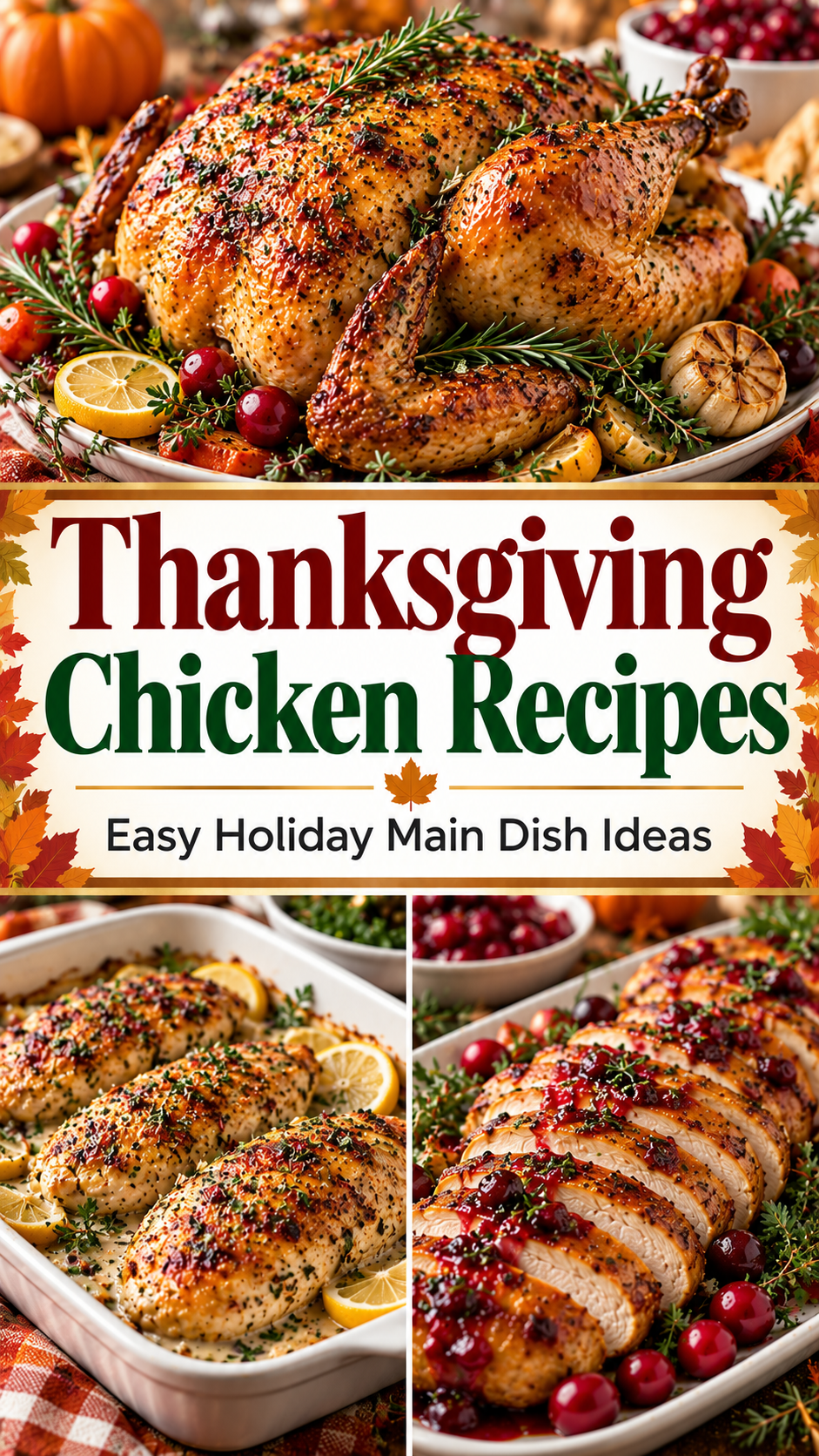
Here are five Thanksgiving chicken recipes I’d consider before committing to a giant bird.
The Classic: Garlic Herb Thanksgiving Roast Chicken
If you want Thanksgiving dinner to look traditional when it reaches the table, start here.
A beautifully browned whole chicken surrounded by herbs still gives you that centerpiece moment—just without needing a roasting pan the size of a small bathtub.
For about 4 to 6 servings, you’ll need:
- 1 whole chicken, about 4 to 5 pounds
- 4 tablespoons unsalted butter, softened
- 4 garlic cloves, minced
- 1 tablespoon chopped fresh rosemary
- 1 tablespoon fresh thyme
- 1 tablespoon chopped fresh sage
- 1 teaspoon lemon zest
- Salt and black pepper
- 1 lemon, halved
- 1 small onion, quartered
- 2 carrots, roughly chopped
- 2 celery stalks, roughly chopped
Heat the oven to 425°F.
Pat the chicken dry with paper towels.
Mix the softened butter with garlic, rosemary, thyme, sage, lemon zest, salt, and pepper.
Carefully loosen some of the skin over the breast and rub part of the herb butter underneath. Spread the remaining butter over the outside.
Place the lemon and some onion inside the cavity without packing it tightly.
Scatter carrots, celery, and remaining onion in the roasting pan and place the chicken on top.
Roast until beautifully browned and completely cooked through.
Rather than relying entirely on cooking time, check the temperature with an instant-read thermometer. Poultry should reach 165°F in the appropriate thickest areas, avoiding contact with bone.
Let the chicken rest for around 15 minutes before carving.
Those pan juices?
Don’t throw them away.
They’re Thanksgiving gravy waiting for instructions.
When You Don’t Want to Carve Anything: Maple Dijon Chicken Thighs
There is a strong argument for serving chicken thighs at Thanksgiving.
They’re flavorful, forgiving, inexpensive compared with many holiday centerpieces, and everyone receives an individual portion.
No carving ceremony required.
For 6 servings:
- 6 to 8 bone-in, skin-on chicken thighs
- 2 tablespoons olive oil
- 3 tablespoons pure maple syrup
- 2 tablespoons Dijon mustard
- 1 tablespoon apple cider vinegar
- 2 garlic cloves, minced
- 1 teaspoon fresh thyme
- 1/2 teaspoon chopped rosemary
- Salt and black pepper
Heat the oven to 400°F.
Pat the chicken thighs dry.
Season them with salt and pepper.
Whisk together maple syrup, Dijon, apple cider vinegar, garlic, thyme, rosemary, and 1 tablespoon of olive oil.
Heat the remaining oil in a large oven-safe skillet.
Place the thighs skin-side down and let them cook until the skin develops good color.
Turn them over.
Brush generously with the maple-Dijon mixture.
Transfer the skillet to the oven and roast until the chicken reaches 165°F internally.
Brush with a little more glaze during cooking if you’d like, making sure any glaze that has contacted raw poultry is thoroughly cooked.
Let the thighs rest briefly before serving.
The maple is subtle rather than dessert-sweet, while Dijon and vinegar keep the glaze balanced.
Serve these beside mashed potatoes and roasted Brussels sprouts and nobody is going to wonder where the turkey went.
The Most Thanksgiving-Looking One: Cranberry Balsamic Chicken
Cranberry sauce doesn’t have to stay in a little bowl beside the turkey.
Here it becomes part of the main dish.
You’ll need:
- 6 boneless, skinless chicken breasts or thighs
- 1 tablespoon olive oil
- Salt and black pepper
- 1 cup fresh or frozen cranberries
- 1/3 cup orange juice
- 3 tablespoons maple syrup or honey
- 2 tablespoons balsamic vinegar
- 1 teaspoon Dijon mustard
- 1 teaspoon fresh thyme
- 1/2 teaspoon orange zest
Heat the oven to 375°F.
Season the chicken with salt and pepper.
Heat olive oil in an oven-safe skillet and brown the chicken briefly on both sides.
It doesn’t need to cook completely at this stage.
Remove it temporarily.
Add cranberries, orange juice, maple syrup, balsamic vinegar, Dijon, thyme, and orange zest to the skillet.
Simmer for several minutes until the cranberries begin bursting and the sauce starts thickening.
Return the chicken to the pan.
Spoon some sauce over each piece.
Transfer to the oven and bake until the chicken reaches a safe internal temperature of 165°F.
The exact cooking time will depend on the thickness and cut of the chicken, so a thermometer is more useful than watching the clock.
The finished sauce should be tart, sweet, savory, and glossy.
If it tastes too sharp, add a little maple syrup.
If it’s too sweet, another small splash of balsamic vinegar can bring it back into balance.
This recipe looks particularly good on a white platter with fresh thyme scattered around it.
Christmas has red and green.
Thanksgiving gets cranberry and thyme.
Fair arrangement.
For Something a Little More Special: Apple Sage Stuffed Chicken
Stuffed chicken breasts take more effort than chicken thighs, but they’re useful when you want individually portioned holiday mains that still feel special.
For 6 servings:
- 6 large boneless, skinless chicken breasts
- 1 tablespoon butter
- 1 small apple, finely diced
- 1 small shallot, finely chopped
- 1 teaspoon chopped fresh sage
- 1/2 teaspoon fresh thyme
- 1 cup baby spinach, chopped
- 1/2 cup shredded sharp white cheddar
- 1/3 cup breadcrumbs
- 1 tablespoon olive oil
- Salt and black pepper
Heat the oven to 375°F.
Melt the butter in a skillet.
Add shallot and apple and cook until they begin softening.
Stir in sage, thyme, and spinach.
Cook until the spinach wilts.
Remove from the heat and allow the mixture to cool slightly.
Stir in cheddar and breadcrumbs.
Carefully cut a pocket into the side of each chicken breast without slicing completely through.
Fill each pocket with the apple mixture.
Don’t overstuff them.
If the chicken looks as though it’s trying to eject the filling before reaching the oven, you’ve been too ambitious.
Secure with toothpicks if necessary.
Season the outside with salt and pepper.
Heat olive oil in an oven-safe skillet and brown the chicken briefly.
Transfer to the oven and cook until both the chicken and its filling reach 165°F.
Let the chicken rest briefly, remove any toothpicks, and serve.
Apple and sage give this one unmistakably autumn flavor without needing cranberry sauce in every bite.
The Easiest Dinner for a Crowd: Sheet-Pan Thanksgiving Chicken
This isn’t the fancy centerpiece recipe.
It’s the one you’ll be grateful you chose when you’re feeding a casual crowd.
Everything cooks together.
For about 6 servings:
- 6 bone-in chicken thighs
- 1 pound baby potatoes, halved
- 1 pound Brussels sprouts, halved
- 2 large carrots, chopped
- 1 red onion, cut into wedges
- 3 tablespoons olive oil
- 3 garlic cloves, minced
- 1 teaspoon dried thyme
- 1 teaspoon dried sage
- 1/2 teaspoon rosemary
- Salt and black pepper
- 1 tablespoon maple syrup
Heat the oven to 425°F.
Toss the potatoes, carrots, and onion with olive oil, garlic, herbs, salt, and pepper.
Spread them across a large rimmed sheet pan.
Roast for about 15 minutes to give the harder vegetables a head start.
Meanwhile, season the chicken thighs.
Remove the pan and add the chicken along with the Brussels sprouts.
Return everything to the oven.
Continue roasting until the vegetables are tender and browned and the chicken reaches 165°F internally.
During the final part of roasting, lightly brush the chicken with maple syrup mixed with a touch of olive oil.
Now you’ve got chicken, potatoes, carrots, onions, and Brussels sprouts from one pan.
Add cranberry sauce and rolls.
Thanksgiving dinner is essentially handled.
Turn the Roast Chicken Drippings Into Gravy
If you’re serving chicken instead of turkey, you can still have Thanksgiving gravy.
After roasting your whole chicken, transfer the bird to a board to rest.
Pour the pan drippings into a heat-safe container and separate excess fat as needed.
For a simple gravy, you’ll need approximately:
- 3 tablespoons fat or butter
- 3 tablespoons all-purpose flour
- 2 to 2 1/2 cups chicken broth plus usable pan juices
- Black pepper
- Salt as needed
Heat the fat or butter in a saucepan.
Whisk in the flour and cook for a minute or two.
Gradually whisk in the broth and pan juices.
Simmer until thickened.
Add black pepper.
Taste before adding salt because the drippings and broth may already be seasoned.
If you want Thanksgiving herb flavor, add a little thyme or sage.
You can also add sautéed mushrooms for mushroom gravy.
Pour that over chicken and mashed potatoes and the turkey will be rapidly forgotten.
Chicken Breast or Chicken Thighs for Thanksgiving?
Both work, but they create very different dinners.
Chicken breasts look neat on a holiday platter and work especially well for stuffed recipes. Their disadvantage is that lean breast meat is less forgiving when overcooked.
Chicken thighs contain more fat and generally stay juicier. They’re excellent for glazes, sheet-pan meals, and recipes that need to wait a little while before everyone reaches the table.
Whole chicken gives you the closest experience to serving Thanksgiving turkey.
For a small traditional Thanksgiving, I’d choose whole chicken.
For a larger casual dinner, I’d use thighs.
For a plated dinner where presentation matters, stuffed breasts are hard to beat.
What Should You Serve With Thanksgiving Chicken?
This is the easy part.
Nearly every traditional Thanksgiving side that works with turkey also works with chicken.
A classic plate could include:
- Mashed potatoes
- Stuffing
- Green beans
- Cranberry sauce
- Roasted carrots
- Brussels sprouts
- Sweet potatoes
- Dinner rolls
- Gravy
You don’t need to redesign Thanksgiving because you changed the bird.
For the Cranberry Balsamic Chicken, I’d choose mashed potatoes and green beans.
With Maple Dijon Thighs, roasted Brussels sprouts and wild rice would be excellent.
For Apple Sage Stuffed Chicken, keep the sides simpler—perhaps mashed potatoes and roasted carrots.
The Sheet-Pan Chicken already contains vegetables and potatoes, so I’d only add cranberry sauce, rolls, and maybe a salad.
That’s the dinner for anyone who wants Thanksgiving without producing enough dirty cookware to fill a second kitchen.
How Much Chicken Do You Need?
For boneless chicken, around 6 to 8 ounces raw per adult is a reasonable starting point, depending on appetite and how many sides you’re serving.
For bone-in pieces, allow more because part of the weight is bone.
If you’re roasting whole chickens for a larger group, two smaller birds can sometimes be more convenient than one very large one.
They also give you more crispy skin.
That’s not a minor detail.
If you’re feeding children and adults together, adjust portions accordingly.
And remember that Thanksgiving usually includes appetizers, several sides, rolls, and dessert.
You don’t need a pound of chicken for every person unless your Thanksgiving tradition involves competitive eating.
Chicken Can Be Better for a Small Thanksgiving
This is where chicken really makes sense.
For 2 to 4 people, roast chicken is usually much more manageable than turkey.
You still get:
- Crispy skin
- Herb-scented pan juices
- Homemade gravy
- A beautiful centerpiece
- Leftovers for sandwiches
You just don’t get enough leftover poultry to begin questioning your life choices by Sunday.
A 4- to 5-pound chicken with mashed potatoes, stuffing, green vegetables, cranberry sauce, and dessert creates a complete Thanksgiving dinner for a small gathering.
And because the chicken cooks faster than a large turkey, your oven is available sooner for side dishes.
That’s a serious holiday advantage.
Make-Ahead Thanksgiving Chicken Prep
Chicken itself is generally best cooked close to serving, but plenty of prep can happen earlier.
Chop herbs the day before.
Prepare the cranberry sauce for the cranberry chicken.
Make the apple-and-sage filling for stuffed chicken, cool it promptly, and refrigerate it separately before assembling.
Wash and chop sheet-pan vegetables.
Mix the maple-Dijon glaze and refrigerate it.
Prepare gravy ingredients and measure everything into small containers.
You can also season some chicken recipes in advance and refrigerate them, depending on the recipe.
What I wouldn’t do is fully cook lean chicken breast a day early unless necessary.
Freshly cooked chicken breast has a much better chance of reaching the table juicy.
Thanksgiving already asks enough of gravy.
It shouldn’t also have to rescue yesterday’s chicken.
Don’t Rinse Raw Chicken
There’s no need to wash raw chicken before cooking it.
Rinsing can spread bacteria through splashing water onto the sink, counters, utensils, and nearby foods.
Instead, move the chicken carefully from its packaging to your preparation area, pat it dry with disposable paper towels when needed, and wash your hands thoroughly afterward.
Use separate cutting boards and utensils for raw poultry and ready-to-eat foods.
And don’t reuse marinade or glaze that has contacted raw chicken unless it is thoroughly cooked first.
The Thanksgiving kitchen is already busy.
Keeping raw-poultry handling simple makes it safer.
Don’t Guess Whether Chicken Is Done
Color isn’t a reliable safety test.
Neither is clear juice.
Use a food thermometer.
Chicken should reach a minimum internal temperature of 165°F.
For a whole chicken, check the appropriate thickest areas without touching bone.
For stuffed chicken, both the meat and the center of the stuffing need to reach 165°F.
For thighs, the safe minimum remains 165°F, although some people prefer cooking dark meat somewhat beyond that for texture.
Once cooked, let the chicken rest briefly before carving or serving.
That helps retain juices and also gives you a few precious minutes to finish the sides.
Leftover Thanksgiving Chicken Might Be the Best Part
Store cooked chicken and other perishable foods in the refrigerator within 2 hours of cooking or serving, or within 1 hour if temperatures are above 90°F.
Keep the refrigerator at 40°F or below.
Most cooked leftovers should be used within 3 to 4 days.
Reheat leftovers to 165°F.
Then turn the chicken into something completely different.
Try:
Thanksgiving chicken sandwiches: chicken, cranberry sauce, stuffing, and a little gravy on toasted bread.
Chicken pot pie: combine leftover chicken with vegetables and creamy sauce under puff pastry.
Chicken soup: use leftover meat with broth, carrots, celery, and noodles.
Chicken and stuffing casserole: layer chopped chicken with leftover stuffing, vegetables, and gravy.
Cranberry chicken salad: chopped chicken, cranberry, celery, pecans, and a creamy dressing.
By day two, nobody needs Thanksgiving dinner recreated exactly.
The leftovers are allowed to develop their own personality.
Which Thanksgiving Chicken Recipe Should You Make?
If you want the closest replacement for turkey, choose the Garlic Herb Roast Chicken.
It looks festive, gives you drippings for gravy, and works with every traditional Thanksgiving side.
If simplicity matters most, make Maple Dijon Chicken Thighs.
For something colorful and unmistakably holiday-inspired, choose Cranberry Balsamic Chicken.
For a smaller dinner that feels a little more elegant, make the Apple Sage Stuffed Chicken.
And for the easiest complete meal?
The Sheet-Pan Thanksgiving Chicken wins.
Chicken doesn’t need to pretend to be turkey to belong on Thanksgiving.
Give it garlic, sage, rosemary, thyme, cranberry, apples, or maple, surround it with the sides everyone actually came for, and you’ve got a Thanksgiving dinner that feels every bit as festive—just considerably easier to manage.